📌 TL;DR
An unpaid full and final settlement rarely needs a court battle. Since November 2025, wage dues must be cleared within two working days of exit, and delayed gratuity carries 10% annual interest.
Escalate in writing, then move the matter to online dispute resolution with CADRE, India’s simplest online dispute resolution platform.
Leaving an organisation on good terms is always ideal. However, even after a smooth exit, the full and final settlement (FnF) process sometimes can bring unexpected delays, errors, or disputes.
Moreover, the rules around exit pay changed on 21 November 2025, when India’s four labour codes came into force. The old norm of waiting 45 to 60 days for a final payout no longer matches the law
While the usual advice is to approach the labour court, litigation is often time-consuming, expensive, and stressful for both employees and employers.
We’ll explain how to review your full and final settlement calculation and resolve disputes quickly through online dispute resolution, without having to enter a courtroom.
What is a full and final settlement?
A full and final settlement is the one-time clearing of everything you and your employer owe each other after you resign, retire, or are let go. It bundles your unpaid salary, encashed leave, gratuity, and allowances, minus any lawful deductions.
Here is what a full and final settlement calculation usually pulls together:
- Pro-rata salary: This reflects the days you actively worked in your last cycle.
- Unused leaves turned into cash: This is tax-exempt up to ₹25,00,000 under Section 10(10AA) of the Income Tax Act, 1961.
- Gratuity: If you completed five years of continuous service (with narrow exceptions). Gratuity now sits under the Code on Social Security, 2020.
- Allowances: These cannot exceed 50% of the total remuneration under modern codes. Any excess is treated as wages.
- Deductions and clearances: Employers can make valid deductions for unreturned laptops or notice buyouts, but not arbitrary business losses without a formal inquiry.
What the law says about final settlement timelines
The law now sets tight windows. Wage dues are payable within two working days of exit, and gratuity within 30 days.
Timelines under the full and final settlement law in India
Section 17(2) of the Code on Wages, 2019, requires wages, including leave encashment, to be paid within two working days of resignation, dismissal, retrenchment, or closure.
The Code came into force on 21 November 2025, replacing the earlier wage laws.
So an employee who exits on a Friday should, in principle, see their wage dues by the following Tuesday, not weeks later.
Gratuity follows a 30-day clock. Where gratuity is paid late, the employer owes simple interest at 10% per year, a rate fixed by a long-standing Central Government notification of 1 October 1987 under the Payment of Gratuity Act, 1972 framework.
While it mostly goes without hassle, in some cases, full and final settlements are not paid properly. To tackle those instances, consider using a follow-up chain before moving to arbitration or litigation.
While it mostly goes without hassle, in some cases, full and final settlements are not paid properly. To tackle those instances, consider using a follow-up chain before moving to arbitration or litigation.
How to build an escalating follow-up chain
Before anything formal, build a clean written trail. A dated record of your claim clears up honest administrative errors and, if talks fail, becomes the backbone of your case.
- Log in to your exit portal, if there is one, and confirm nothing is marked pending.
- Email HR with your claim. Include employee ID, resignation acceptance, and your exact calculated dues.
- If that is ignored, send a firm follow-up email restating the numbers and setting a clear 7- to 10-day deadline.
- If email still draws silence, have a lawyer send a legal notice for full and final settlement. It should set out the amounts owed and the employer’s obligations under the Code on Wages, 2019, with a fixed compliance window, commonly 15 days.
Why labour courts can be challenging for individual employees
Traditional methods of settlement of industrial disputes rely heavily on labour courts.
For a single worker trying to progress in their career, court litigation is often too slow and expensive.

Also, lawyer fees can quickly exceed the actual settlement amount. Public court battles also expose sensitive contract details, which can harm your reputation during future background checks.
While courts remain vital for major industrial conflicts, individual payment matters need an alternative approach.
Resolving exit payment disputes digitally without court
Online dispute resolution (ODR) is a private, formal way to settle the matter online through mediation or conciliation, and Indian law recognises and enforces the outcome.
The online dispute resolution framework
ODR uses secure digital platforms to settle disputes quickly and fairly. While it’s often used for settlement of consumer disputes through online dispute resolution, it also works well for workplace and exit-related contracts.
With CADRE, you can upload your exit contract online. A certified professional reviews the case and helps both sides reach a fair settlement within 45 days.

Once signed, the settlement is binding under Section 73 of the Arbitration and Conciliation Act, 1996, and can be enforced like a civil court decree under Section 36 once the challenge window under Section 34 passes.
This helps employers protect their public reputation while closing financial matters faster.
Forum comparison for dispute settlement
Here is a quick comparison of different methods to secure full and final settlement:
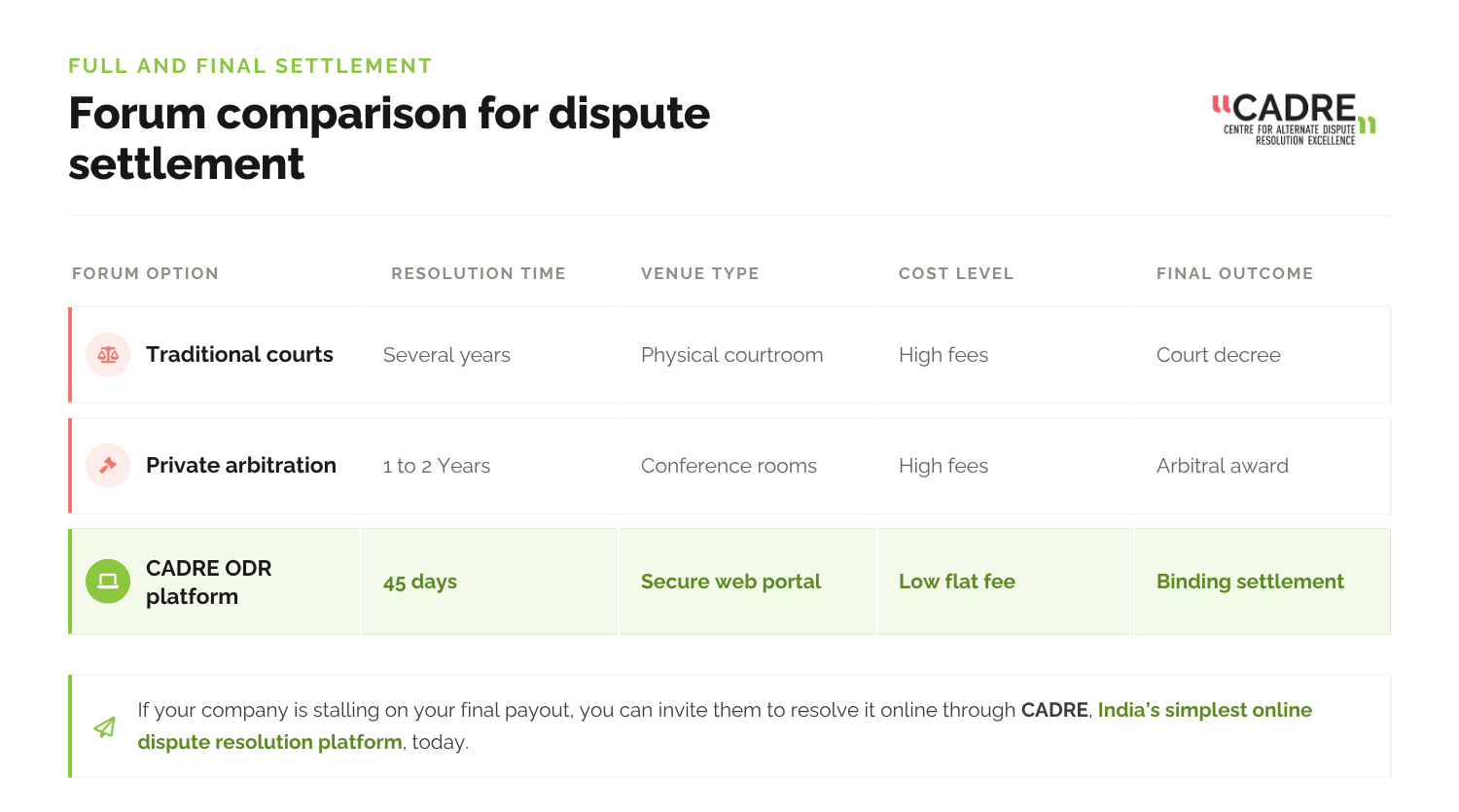
If your company is stalling on your final payout, you can invite them to resolve it online through CADRE, India’s simplest online dispute resolution platform, today.
Resolve your payout dispute
You do not have to choose between walking away from your earned money or spending years in a slow labour court.
The labour codes have shortened the legal clock on your side; wage dues in two working days and gratuity in thirty, so a delayed settlement now sits on weak ground.
Settle your exit dues quickly and amicably through secure digital mediation. Choose CADRE, India’s simplest online dispute resolution platform, to resolve your workplace payment dispute safely today.
FAQs for full and final settlement
Wages were due within two working days of exit under Section 17(2) of the Code on Wages. Gratuity was due within 30 days under Section 56(3) of the Code on Social Security, with simple interest at the notified rate.
This is the complete financial reconciliation that takes place when you leave a job. It contains your unpaid salary, leave encashment, and gratuity, minus legitimate company recoveries like notice buyouts or unreturned physical assets.
In India, this refers to the common three-month corporate contract notice period, or the state law rule where completing three months of continuous work triggers basic statutory notice protections.
Wage dues rank as a claim against the company. Where insolvency has begun, take advice on filing as an operational creditor.