TL;DR
A debt collection agency works on a commission model, helping lenders recover their unpaid dues. It’s better suited for new, undisputed accounts.
On 6 August 2026, the RBI rewrote the rules for engaging and supervising recovery agencies. They take effect on 1 January 2027 and cover banks, co-operative banks, NBFCs, housing finance companies and all-India financial institutions.
An agency can ask for payment. It cannot decide a dispute or enforce anything.
For disputed accounts an agency cannot close, CADRE, India’s simplest online dispute resolution platform, uses arbitration, mediation, and conciliation to recover dues without the time, cost, or strain of court.
Every lender in India sits on overdue accounts that polite reminders never shift, and the pile grows as retail and unsecured lending expands.
What happens to those accounts is visible in the RBI’s own numbers: write-offs accounted for 31.8% of scheduled commercial banks’ gross NPAs in FY25, up from 29.5% the year before, and private banks accounted for 81.9% of write-offs in the unsecured retail segment. A large part of what gets called recovery ends as an accounting entry.
Somewhere before that point, someone decides how to chase the money, and the usual first call is to a debt collection agency. That is often the right call. The complication is that an agency suits a fairly narrow kind of debt, and that whatever it does in your name stays your responsibility.
The rules on that responsibility change on 1 January 2027. This guide covers how agencies work, what they charge, where they stop being useful, and what the new RBI framework will require of you.
This is general information, not legal advice on a specific matter.
What a debt collection agency does
A debt collection agency is a third-party firm that recovers overdue payments for a lender or business, in exchange for a fee. It steps in when a lender’s own reminders have run their course, taking over contact with the borrower.
An agency’s work runs on persuasion and steady follow-up. It reaches the borrower, negotiates a repayment plan, and keeps a clear record of every interaction for the lender.
The demand for these agencies is rising fast, especially in India. FactMR projects India to be among the fastest-growing debt collection markets, at roughly 4.5% CAGR through 2036.
Behind that growth is India’s lending boom. Digital lenders and NBFCs have pushed out a wave of small, unsecured loans, and some go unpaid. These defaults are often too small to take to court, so lenders hand them to debt collection companies built to chase volume.
What are the different types
Debt collection firms differ in method, sector focus, and how far they can push a case.
- In-house recovery teams: Handle recovery with the lender’s own staff or bank representatives, before an account is outsourced.
- Third-party agencies: Work on commission as independent debt collection firms a bank or NBFC empanels to chase outsourced accounts.
- NBFC collection agencies: Specialise in NBFC loan books, from personal and vehicle loans to small business credit.
- Microfinance collection agencies: Recover high-volume, small-ticket microfinance and group loans, often in rural areas.
- Asset reconstruction companies: Buy stressed or NPA loans from lenders and recover them under RBI registration and the SARFAESI Act.
A glance at debt collection agency services
A lender can hire an agency for a single stage or the full recovery cycle, matched to the account. The core debt collection agency services include:
- Sends payment reminders on your behalf
- Makes follow-up calls and runs field visits
- Negotiates repayment plans and settlements
- Lawfully traces borrowers who go quiet
- Manages delinquent accounts across your portfolio
- Assists with secured-asset recovery, where authorised
- Reports every contact, promise, and payment
How the debt collection process works
Agencies don’t chase every account the same way. It moves through stages, and each one escalates only when the previous, softer step fails. The later the stage, the more it costs and the more pressure it signals.
- Reminders: The process starts with automated SMS, WhatsApp, email, and calls nudging the borrower to pay. Most recoveries close here.
- Tele-calling: If reminders go unanswered, trained agents call repeatedly to agree on a date or a repayment plan.
- Field visits: When calls fail, an agent meets the borrower to collect or settle in person.
- Skip tracing: If the borrower cannot be reached, the agency locates a new number, job, or address.
- Legal notice: As a last push, the borrower gets a formal warning that court action may follow.
- Handoff: The file then returns to the lender, who decides whether to take legal action.
What a debt collection agency charges
Most agencies charge a commission on what they recover, so you pay only when they recover money. This is the contingency model, and it dominates because it ties the agency’s fee to results. A few other structures exist for specific needs.
- Flat fee: A fixed charge per account, used for high-volume, low-value books.
- Hybrid: A small base fee plus a success commission on recovery.
- No win, no fee: The same contingency idea, sold on outcome, with payment only on recovery.
The commission is not fixed. It climbs as a debt gets older, smaller, or harder to collect, because the agency’s odds of recovering it fall. Age moves the rate the most.
What does recovering ₹2 lakh cost through an agency?
Take a ₹2,00,000 invoice, 85 days overdue, placed with an agency at a 20% contingency rate.
- Full recovery: The fee is ₹40,000, and you keep ₹1,60,000.
- Half recovered: The fee is ₹20,000, and you keep ₹80,000.
- Nothing recovered: You pay nothing, but the debt is still unpaid.
Legal costs, if the case escalates to court, sit outside this fee and are billed separately. The rate itself is not the real cost. That same 20% returns far more on a fresh account than on months-old debt. What you get back depends on how fast the account is placed.
Is a debt collection agency in India legal?
Yes, debt collection agencies are legal in India. No single statute licenses them, so two layers apply: RBI rules governing agents’ conduct and laws governing debt recovery.
RBI rules on agent conduct
The RBI’s Fair Practices Code and recovery-agent norms set the boundaries agents work within. They may contact a borrower only between 8 a.m. and 7 p.m., cannot harass or shame, and must carry proof of authority. The lender stays responsible for every agent acting in its name.
Recovery agents must also complete certification from the Indian Institute of Banking and Finance (IIBF), a longstanding RBI requirement. A 2026 overhaul of RBI’s conduct directions reinforces it further, with new rules for banks effective from January 2027.
The laws behind debt recovery
Recovery in India runs on a handful of statutes, and which one applies depends on the lender and the debt.
- Indian Contract Act, 1872: Governs the loan agreement itself and lets a creditor sue to recover the money owed.
- Negotiable Instruments Act, 1881: Criminalises cheque dishonour under Section 138, a common route to recover a bounced payment.
- Recovery of Debts Due to Banks and Financial Institutions Act, 1993: Establishes Debt Recovery Tribunals for banks and financial institutions for claims of ₹20 lakh and above.
- SARFAESI Act, 2002: Lets secured lenders enforce collateral without going to court, open only to notified institutions.
- Insolvency and Bankruptcy Code, 2016: Handles corporate defaults above ₹1 crore as insolvency resolution, so it cannot be used to force a disputed debt.
- MSMED Act, 2006: Gives registered micro and small enterprises a delayed-payment claim through the MSME Samadhaan route.
Can agencies take legal action?
No, debt collection agencies cannot sue a borrower or seize assets on their own. They can issue a legal notice and prepare the file, then hand the matter back to the lender or its lawyers. The court and tribunal routes stay with the lender.
Moreover, outsourcing recovery does not outsource the responsibility. Under RBI rules, the lender stays fully accountable for how its agents behave.
A harassing agent becomes the lender’s problem too. Complaints and penalties land on the regulated entity, with reputational damage on top.
Data adds another layer. Under the Digital Personal Data Protection Act, 2023, the lender remains answerable for borrower data it shares with an agency. The takeaway: an agency that cuts corners on conduct can cost a lender far more than it recovers.
What changes on 1 January 2027
On 6 August 2026, the RBI issued nine parallel sets of amendment directions on the conduct of regulated entities in the recovery of loans and the engagement of recovery agents.
They take effect on 1 January 2027, and they cover commercial banks, small finance banks, local area banks, regional rural banks, urban and rural co-operative banks, all-India financial institutions, NBFCs and housing finance companies. If you are a regulated lender using a collection agency, the arrangement you have today was built for the old framework.
4 changes matter most for how you engage an agency:
1. Certification stops being good practice. Individual recovery agents must hold the Indian Institute of Banking and Finance’s debt recovery agent certification, and agents taken on after the directions apply must be certified before they are engaged. If your agency cannot produce certificates for the named individuals working your book, that is a gap in your file.
2. Contact rules get tighter and more specific. The 08:00 to 19:00 window stays. Added to it: a borrower must receive notice at least a day before a recovery agent’s first visit, and the agent must carry an identity card, an authorisation letter and a copy of the notice on every visit. The prohibition on applying pressure through social media is now explicit, and covers posting a borrower’s personal information, photographs, video or audio.
3. Supervision has to be demonstrable. The lender must be able to show a management structure that monitors and controls what its recovery agencies do, with contractual rights to enforce it. Responsibility for an agent’s conduct has sat with the regulated entity for years, so what the directions add is a requirement to evidence how that responsibility is discharged. An auditable record of every contact is what makes that possible.
4. Borrowers get a compensation route. Lenders must provide for compensation where a recovery action breaches the directions and causes loss. The clearest case is device financing: where a financed handset is wrongly restricted or restoration is delayed, compensation runs at ₹250 per hour, capped at the loan amount disbursed.
Restrictions cannot begin before the account is 30 days past due, essential functions such as incoming calls, SMS and emergency calling cannot be disabled, and full restriction is permitted only after 60 days.
What a debt collection agency cannot do
Collection firms cannot make a borrower pay and cannot decide a dispute.
- Settling a disputed debt: Where the borrower contests the amount, only a court, tribunal or arbitrator can rule on it. An agency has no power to decide who is right.
- Seizing assets: Agents cannot repossess a vehicle or take property by force. That needs due legal process, and for secured loans the SARFAESI route.
- Forcing a refusing borrower to pay: An agency cannot attach a bank account or a salary, so a solvent borrower who simply refuses cannot be compelled. Enforcement needs a decree or an award.
- Handling an insolvent borrower: A company that genuinely cannot pay belongs in insolvency proceedings under the IBC.
When a debt collection agency works best
If your debt is recent and uncontested, a collection agency is your best option. It works across account types, from unsecured loans and credit-card balances to unpaid invoices and cheque-bounce cases.
You pay only a commission on what comes back, with no upfront legal spend and no court timeline to sit through.
Beyond the economics, an agency brings:
- Scale on demand: Work thousands of accounts at once and free your team from chasing them.
- Specialist skills and tools: Skip tracing, negotiation, and borrower databases a finance team rarely keeps.
- Wider reach: Regional-language callers and field agents cover cities and languages you cannot.
- Relationship intact: Persuasion recovers the money while keeping a borrower you may lend to again.
- A clean audit trail: Every call and visit is logged, which strengthens the file if it later goes legal.
- Faster cash flow: Recovered money returns to working capital far sooner than a court route allows.
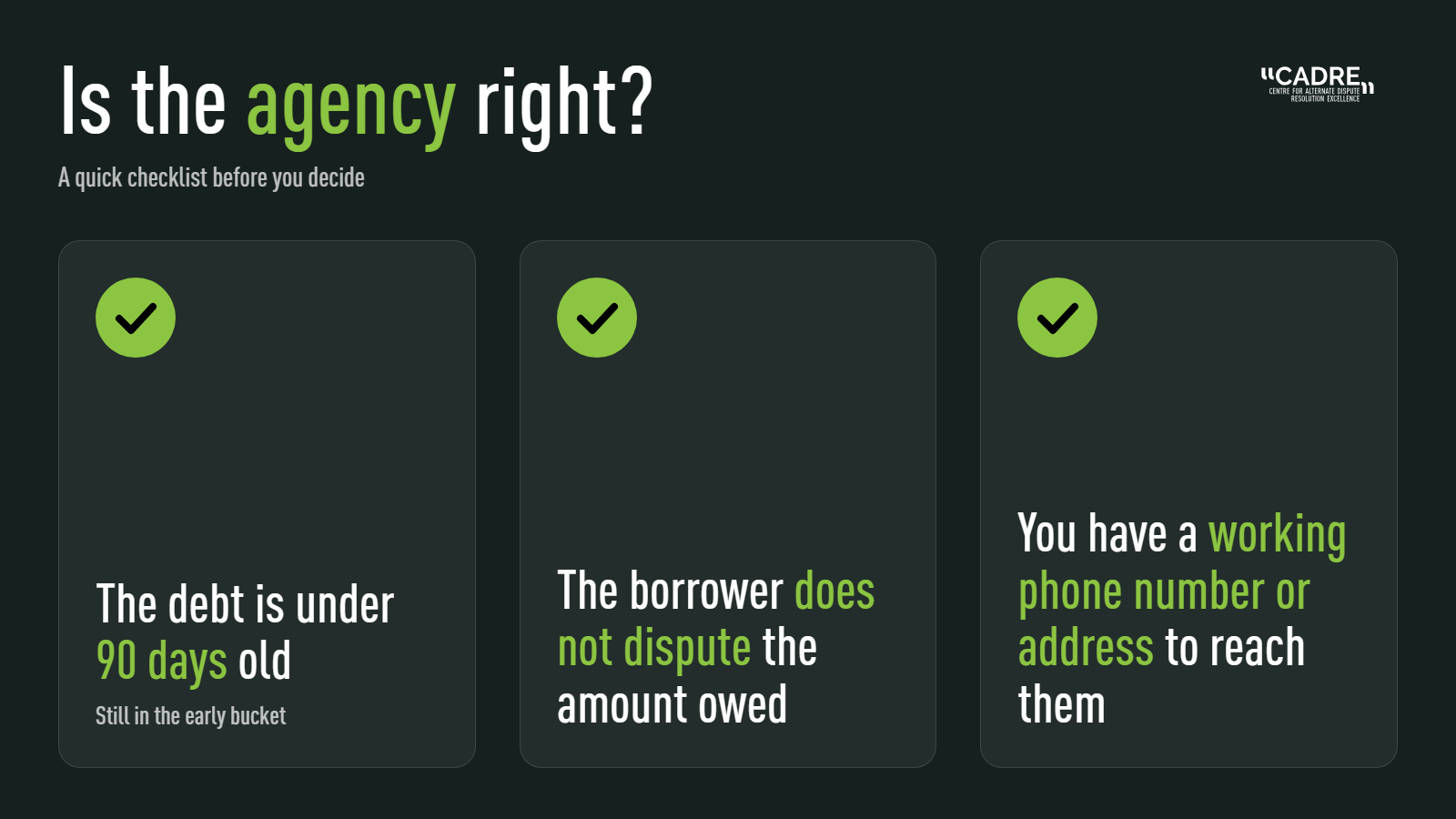
Use this quick checklist before deciding whether the agency is right:
- The debt is under 90 days old, still in the early bucket.
- The borrower does not dispute the amount owed.
- You have a working phone number or address to reach them.
Agency vs in-house vs software vs ODR
Four routes, each suited to a different kind of debt. None of them wins on every account. For the wider picture on out-of-court options, see our complete guide to alternative dispute resolution.
| Aspect | Collection agency | In-house team | Debt collection software | ODR |
| What it does | Outsourced chasing and persuasion | Your own staff chase dues | A tool to run and track collections | Online arbitration, mediation, conciliation |
| Cost model | Commission on recovery, negotiated per portfolio | Salaries and overhead | Monthly subscription, priced per user | Fee per case or share of claim |
| How it recovers | Calls, field visits, notices | Own team calls and follows up | Automates reminders; staff still make contact | A neutral rules or settles |
| Best debt stage | Early, undisputed | Early to mid, own book | Early to mid, undisputed | Contested, aged, small-to-mid value claims |
| Handles disputed debt | No | No, can negotiate, cannot decide | No | Yes |
| Binding, enforceable outcome | No | No | No | Yes |
| Compliance and data control | Lender liable for the agent | Full control | Depends on the vendor | Neutral, auditable process |
What each option suits best
- Collection agency: High-volume, early, undisputed accounts, and strong for B2B and corporate debt collection where borrowers are reachable.
- In-house team: A steady book where you want full control over how borrowers are contacted and handled.
- Debt collection software: The layer that runs an agency or an in-house team, not a debt recovery route on its own.
- ODR: Contested or aged debt, typically small- to mid-value, that needs a fast, binding, enforceable outcome.
How to choose a debt collection agency
The lender carries the risk for how an agency behaves, so vet on conduct first, then cost and fit. Ask for proof before you sign, and check it yourself.
- DRA-certified, RBI-compliant agents: Ask for IIBF certification records and how the agency enforces the 8 a.m. to 7 p.m. calling rule.
- Data security: Check where borrower data sits, who can access it, and insist on a data-processing agreement; ISO 27001 is a strong signal.
- Recovery track record: Request recovery rates split by debt age and sector; a blended headline number hides weak spots.
- Portfolio fit: Confirm they handle your kind of debt, from retail EMIs to corporate debt collection, with references to match.
- Transparent fees: Get the full rate card, including the aged-debt surcharge, any minimum fee, and what counts as a recovery.
- Reporting and audit trail: Require weekly MIS, call recordings, and a named escalation contact, useful if a case later turns legal.
- Coverage where your borrowers are: Check that they have field agents and regional-language callers where your borrowers are based.
So, which recovery route fits your account?
Stop treating recovery as one process. Segment the book by age and dispute status, and route each bucket to the approach built for it.
An agency delivers on early, undisputed, contactable accounts. Push contested or aged debt to it, and you pay a rising commission for a falling return.
The agency you pick is a risk decision. A lender stays liable for its agents’ conduct and the borrower data they touch, so choose carefully.
Before you sign, ask for two things: recovery rates by bucket and the complaint record. An agency that shares both can be trusted with your borrowers and your name.
For the disputed or stuck accounts an agency cannot close, you need a binding outcome.
CADRE India’s simplest online dispute resolution platform delivers one through arbitration, mediation, and conciliation with end-to-end support. It has handled 35,000+ disputes and over ₹1,000 crore in claim value across banking, MSME, and commercial matters, most within 45-90 days.
FAQs on debt collection agencies
Yes, when the debt is recent, undisputed, and the borrower is still reachable. A collection agency is worth its commission on accounts that mainly need steady follow-up. It loses value once the borrower disputes the amount or goes silent, since calling cannot force a binding order. Weigh the commission against the account’s age and collectability.
Under the Limitation Act, 1963, most money debts must reach court within three years. The clock usually starts when payment fell due or was last acknowledged in writing. A written acknowledgement or part-payment before it expires resets the period. After three years, the debt is time-barred, so the lender cannot sue, though the debt is not cancelled.
No Indian rule says a debt vanishes after seven years. That idea comes from United States credit-reporting law and has no basis here. In India, the actual clock is the three-year limitation period to sue. A default can sit on your credit record for years, but the borrower still owes the money.
It depends on the fee model. On a contingency or no-win, no-fee basis, you pay only a commission on what is recovered, so nothing collected means nothing owed. On a flat-fee or retainer model, you pay regardless of the result. Confirm which model applies, and what counts as a recovery, before you sign.
Yes, agencies routinely work non-performing and written-off accounts. A write-off is only an accounting entry, so the borrower still owes the money legally. Recovery rates on these aged accounts are low, and commissions are usually higher. If the borrower disputes or cannot be traced, a binding route works better than calling.