TL;DR
Skip tracing is lawful for a regulated lender pursuing its own borrower. The limits are tighter than most collection operations assume.
The DPDP exemption lenders rely on, Section 17(1)(f), covers ascertaining a defaulter’s assets and liabilities. It doesn’t obviously cover finding out where they live, which is what most tracing actually is.
Most DPDP obligations become enforceable on 12 May 2027.
CADRE administers the step after tracing: turning a located borrower into a binding, enforceable outcome.
In most collections books, there is a group of accounts that nobody has been able to contact for months. The phone number on file doesn’t connect, the address is out of date, and the borrower hasn’t responded to anything sent since the account went overdue.
A large share of these are eventually written off, in many cases where the borrower had the capacity to pay, because the lender was never able to open a conversation.
Skip tracing in debt recovery is how a lender gets them back into a process. It is also, now, a regulated data activity, and the exemption most lenders assume covers it is narrower than it looks.
What follows is which sources you can actually use, where the law stops the search, and what changes on 12 May 2027.
This is general information about the law, not legal advice on a specific matter.
What is skip tracing in debt collection
Skip tracing is the process of locating a borrower who has stopped being reachable – the term comes from “skipping town”.
In a lending context, it means refreshing contact data against sources the lender is permitted to query, and confirming the result belongs to the right person before anyone calls.
Here is the distinction that runs through the rest of this piece, because Indian law treats the two halves differently:
Contact tracing answers where is this person and how do I reach them. A current number, a working address, an email that is active.
Asset tracing answers what do they have and what do they owe. Property, security interests, directorships, other borrowings.
Collections teams run both through the same vendor, the same queue, and the same approval. The DPDP Act does not treat them the same way, and that gap is where the compliance exposure sits.
3 kinds of missing borrowers that you should know about
Tracing costs roughly the same per account, regardless of the kind you’re dealing with. But understanding the case and the borrower’s action does have a big impact on what you can recover.
| What you’re looking at | What it needs | What it costs you to get wrong | |
| Moved, not hiding | Job change, marriage, a new city. Digital footprint still active. Nobody is avoiding you. | A bureau refresh and a multi-channel notice. Usually enough. | Very little but teams routinely escalate these to field visits, which is pure waste |
| Actively avoiding | Numbers blocked, SIM discarded, no forwarding address, assets moved | Statutory process. Court-supervised disclosure, not more phone calls | Months of agent cost chasing someone who has already decided |
| Possible fraud | Forged documents, identity misuse, a borrower who may never have existed | Escalation to law enforcement and your fraud-risk function | Chasing a fabricated identity through a collections pipeline, indefinitely |
The second category is where judgement is crucial. There is a point at which the tracing and agent spend on an account exceeds anything realistically recoverable from it, and most books cross that line on a meaningful slice of accounts without anyone recording the decision.
Write-off is a legitimate commercial outcome. Discovering it after 18 months of billed effort is not.
Is skip tracing legal in India?
Yes, when carried out for a permissible purpose such as recovery by a regulated lender or its authorised agent. Also, it shall be within the DPDP Act, 2023, the CIC (Regulation) Act, 2005, and the RBI Fair Practices Code.
Whether a specific act of tracing is lawful, though, depends on several factors together:
- The data source: Is it one the lender is actually permitted to use for this purpose?
- The lender’s authority and access rights: Different entities have different rights of access; being a bank, an NBFC, an ARC, or a recovery agent changes what is available.
- The applicable legal framework: The DPDP Act, CICRA, the RBI Fair Practices Code, and the constitutional right to privacy all apply at once.
- The type of information obtained: Contact data, financial data, and location data each carry different obligations.
- How the information is used: The same data can be used lawfully for structured recovery and unlawfully for intimidation.
- Restrictions on disclosure to third parties: Even lawfully held data cannot be shared freely with family, employers, or others.
An unauthorised source, an impermissible use, or an improper disclosure can make otherwise routine tracing unlawful.
The part lenders get wrong about Section 17(1)(f)
Raise DPDP compliance with a collections team, and you’ll usually be told there is an exemption for defaulters. There is, but it is narrower than the way it gets quoted. Section 17(1)(f) of the DPDP Act, 2023 switches off most of the Act’s obligations where personal data is processed
“for the purpose of ascertaining the financial information and assets and liabilities of any person who has defaulted in payment due on account of a loan or advance taken from a financial institution.”
The exemption attaches to ascertaining financial information, assets and liabilities. It doesn’t say locating nor mention contact details, current address or telephone number.
Finding out what somebody owns and finding out where they sleep are different activities, and the drafter named only one of them.
This is a reading, not settled law. No court has construed clause (f), and a lender could argue that locating a defaulter is a necessary step in ascertaining their assets. That argument may well succeed. But it is an argument, and anyone building a tracing stack on the assumption that clause (f) covers the whole exercise should know they are relying on one.
What are the main skip tracing sources a lender may use
| Source | Basis and access | What to watch |
| Internal CRM and CKYC re-verification | RBI KYC Master Direction; the reporting entity’s own permitted use | Tied to the existing relationship, and not a shared search facility across group entities |
| Credit information report (CIBIL, Experian, CRIF, Equifax) | CICRA, 2005, as a specified user for a permissible purpose | Your own borrower and your own purpose. Not a route into another lender’s file |
| MCA company and directorship data | Public search under the Companies Act, 2013 | Confirms directorships and registered office addresses. A public register is not a licence to build a profile |
| Sub-registrar and land records, CERSAI | Registration Act, 1908; CERSAI under SARFAESI, 2002 | Asset-side only. Match the record to your borrower before relying on it, as common names cause real errors |
| Insolvency status (IBBI) | Insolvency and Bankruptcy Code, 2016 | Goes to whether recovery can continue at all. Insolvency is not wilful default |
| Wilful-defaulter classification | Master Direction on Treatment of Wilful Defaulters and Large Defaulters, 30 July 2024 | A classification reached through show-cause, committee review and a personal hearing, and reported to the bureaus |
| Court-supervised disclosure | CPC, 1908, Order XI and Order XXI Rule 41 | The only route under which the borrower can be compelled to disclose |
| Field enquiry | RBI Fair Practices Code and RBI/2022-23/108 | Physical confirmation of an address, with no third-party disclosure and no conduct intended to be noticed |
An unintentional skip usually needs no more than a credit-bureau refresh. A deliberate evader calls for statutory asset tracing.A suspected fraud skip should be escalated to law enforcement, not chased through debt collections tools.
Skip tracing tools in India
The market for skip tracing tools in India includes comprehensive collection software platforms, direct credit bureau feeds, and data aggregators.
Identifying two legally verified phone numbers is far safer than scraping twenty unverified web contacts, which increases the risk of unlawfully calling third parties.
Capability does not equal permission. While some software can sweep social media or telecom logs, utilising these methods against Indian borrowers violates strict statutory boundaries.
Where tracing stops and the legal line in India
Indian privacy laws and banking guidelines strictly limit how far a lender can go to find a missing borrower.
The line is drawn by the DPDP Act, 2023, the RBI’s fair-practice and recovery-agent rules, and the constitutional right to privacy, and crossing it can cost far more than the debt itself.
Under the DPDP Act, 2023, and the DPDP Rules, 2025, every recovery contact and database query is an act of processing, governed by purpose limitation, data minimisation, and notice.
- Section 17(1)(f) does exempt processing to ascertain a loan defaulter’s financial information, assets, and liabilities.
- The core obligations under Sections 8(1) and 8(5) survive, and the exemption is expressly “subject to” disclosure provisions in other laws.
- If a lender or its agency fails to keep the traced portfolio secure, the Data Protection Board may impose penalties that can extend up to ₹250 crore for a security-safeguard failure.
What changes on 12 May 2027
The DPDP Rules were notified on 14 November 2025 and the Act is commencing in phases. The institutional provisions are already live, consent-manager registration follows in November 2026, and the obligations that bear directly on a tracing operation – notice, consent, reasonable security safeguards and breach notification – commence on 12 May 2027.
That leaves a transition period with a fixed end date, and three things worth doing inside it.
- The first is to write down the legal basis for each source you query: a line per source naming the statute or permission relied on and the person who approved it. This is the document a regulatory inquiry would ask for, and it is very difficult to assemble after the fact.
- The second is to find out where your traced data physically sits. The ₹250 crore figure in the Schedule to the DPDP Act attaches to a failure to maintain reasonable security safeguards, and a good deal of tracing output in this market currently lives in spreadsheets on agency laptops.
- The third is to revise the contract with your tracing vendor. The lender is the data fiduciary, so a vendor’s breach becomes the lender’s penalty, in the same way that an agent’s conduct is already the lender’s liability under the 2022 circular.
A compliant tracing workflow
A safe tracing process moves systematically from internal records to official databases while maintaining clear audit trails.
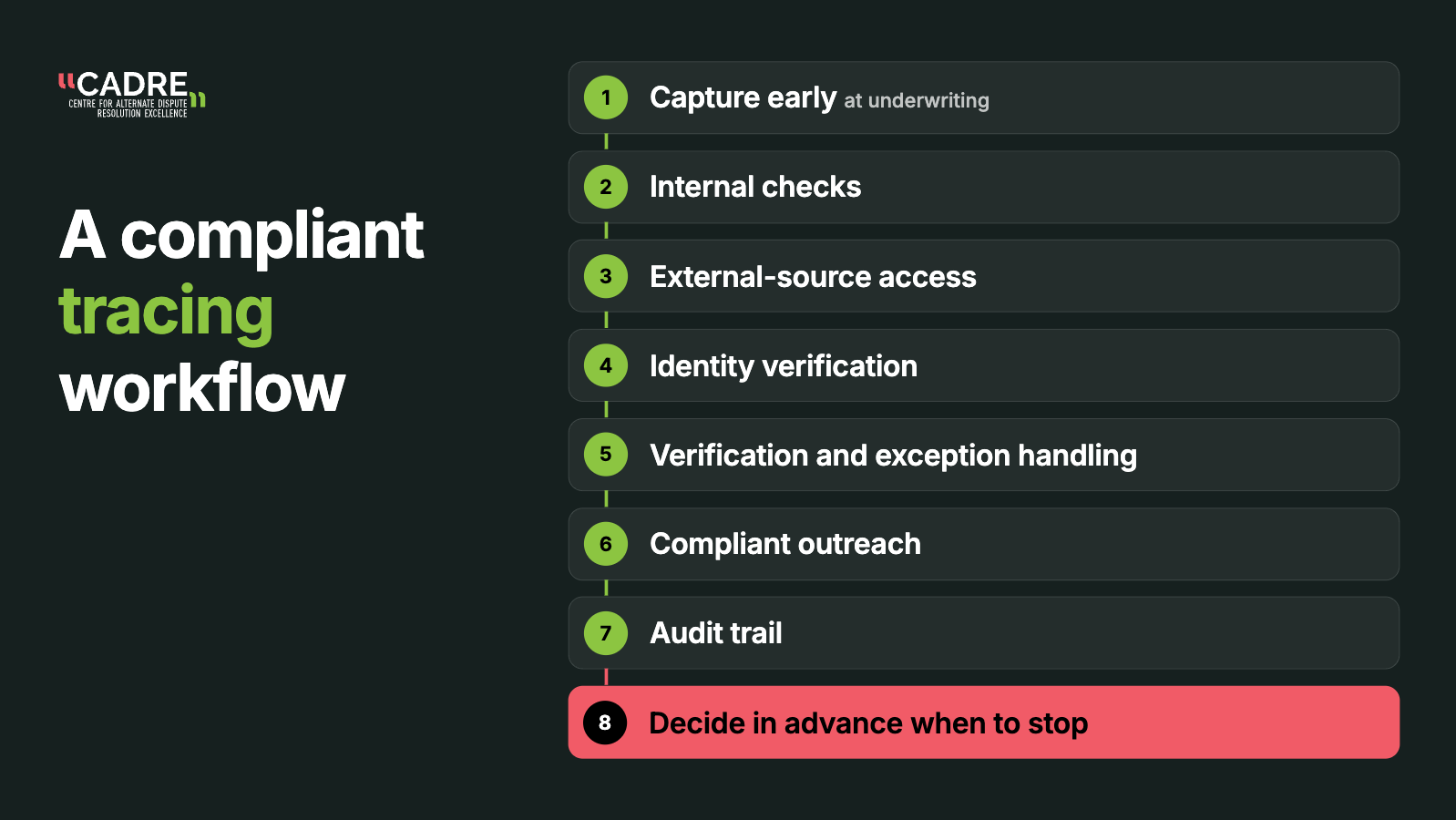
Lenders can mitigate regulatory risk by following this sequential workflow:
- Capture early (at underwriting): Secure verified alternate contacts and consented references, so tracing later starts from good data.
- Internal checks: Re-verify CRM and CKYC details within the institution’s permitted use.
- External-source access: Query the permitted sources per their access conditions: public registries, CICRA bureau access for a permissible purpose, and court process where needed – assessing both the right to access and the right to use.
- Identity verification: Confirm that a located number or address genuinely belongs to the borrower before any outreach, so an unrelated or same-name person is not contacted.
- Verification and exception handling: Flag and route out deceased, insolvent, disputed, or suspected-fraud accounts; hold contact where a dispute or complaint is pending, rather than pushing them through the standard outreach path.
- Compliant outreach: Contact only the borrower or guarantor, strictly within 8:00 AM–7:00 PM, with identity disclosure and no third-party disclosure.
- Audit trail: Log every source, query, and contact so the process can be defended.
- Decide in advance when to stop. Set the point at which an account leaves the tracing queue, whether by exposure, age, or number of attempts, and record the decision.
Locating the borrower is only half the task; a recovery outcome still has to be secured.
Importance of an arbitration clause
A well-drafted arbitration clause enables lenders to secure a binding personal money award for contractual shortfalls.
Banks often pursue SARFAESI for physical collateral alongside arbitration for the remaining balance.
While statutory Debt Recovery Tribunal claims (Vidya Drolia) and mandatory consumer arbitration (Emaar MGF) are legally restricted, pure commercial dues are fully arbitrable.
For these matters, CADRE, India’s simplest online dispute resolution platform, utilises human neutrals to deliver binding, enforceable awards (Sections 35 and 36) faster than typical court timelines with lower recovery costs.
From locating the borrower to recovering the debt
Finding a borrower makes it possible to serve, hear and negotiate with them, but it settles nothing about whether the amount claimed is correct.
Where a valid clause exists, arbitration or ODR turns a located borrower into an enforceable outcome.
CADRE (India’s simplest online dispute resolution platform) administers arbitration, mediation and conciliation online, from first notice to award, with bulk intake, multi-channel notices with delivery tracking, a dedicated case officer on each matter and a single auditable record throughout.
FAQs for skip tracing in debt collection
Yes, when carried out for a permissible purpose such as recovery by a regulated lender or its authorised agent, and within the DPDP Act, 2023, CICRA, 2005, and the RBI Fair Practices Code.
It must rely on authorised databases, credit bureaus, and lawful public records, and avoid harassment, hacking, or unauthorised third-party disclosure.
Avoidance rarely works and does not make the debt disappear. A default stays on record with credit bureaus under CICRA, 2005, and a located borrower can be pursued through lawful recovery, including an enforceable arbitral award where a valid clause exists.
Engaging early, through settlement, restructuring, or online dispute resolution, is generally more constructive than ignoring contact.
The 7-7-7 rule, also called the 7-in-7 rule, is a United States concept under the CFPB’s Regulation F, which presumes harassment if a collector makes more than seven calls in seven days about a particular debt, or calls within seven days of a phone conversation.
It does not apply in India. Here, contact is instead governed by the RBI Fair Practices Code, calls only between 8:00 AM and 7:00 PM, with no harassment, and the DPDP Act, 2023, which sets no numerical limit but treats excessive, intrusive contact as potentially disproportionate.
Only partly. Section 17(1)(f) disapplies most obligations where data is processed to ascertain the financial information, assets and liabilities of a loan defaulter. Accountability and reasonable security safeguards survive under Sections 8(1) and 8(5), which the section names expressly. The exemption is framed around ascertaining assets rather than locating a person, so it should not be assumed to cover contact tracing.