📌 TL;DR
An arbitration clause is an agreement to resolve certain disputes through arbitration rather than in court. It often gives you a faster and more private route than litigation.
By choosing this route, businesses secure faster decisions.
Using a modern clause through CADRE, India’s simplest online dispute resolution platform, can help you handle commercial disputes efficiently and, where suitable, entirely online.
When business partners sign a contract, they focus on prices, deadlines, and delivery terms. Tucked into the agreement is another provision that decides how they will handle any future disagreement: the arbitration clause.
By agreeing to this clause, the parties commit to resolving certain disputes through arbitration. However, courts can still be involved in some cases.
Moreover, under Section 16 of the Act, an arbitration clause is also treated as an agreement independent of the main contract.
Knowing how to use an arbitration clause can save your business months of stress and avoidable legal costs.
What is an arbitration clause? Meaning and business use
An arbitration clause is an agreement between parties to refer all or certain disputes arising from a defined legal relationship to arbitration.
This can cover disputes that may arise in the future or ones that have already arisen, and the relationship need not be contractual.
How arbitration clause works in practice
The arbitration clause rests on a mutual choice to change who decides the merits of the dispute, rather than bypassing courts entirely.
When a dispute arises, it is decided by one or more neutral arbitrators instead of a judge. An arbitrator derives authority from the agreement and applicable law, and their decision binds the parties.
For example, if an engineering firm and its cement supplier include an arbitration clause and a payment or quality dispute arises, either party can still file a suit.
However, the other party can ask the court to refer the matter to arbitration if done correctly under Section 8.
The courts also grant interim relief under Section 9, meaning the clause does not sever every link with the judiciary.
How online dispute resolution is changing arbitration
Online dispute resolution (ODR) is gradually shifting Indian arbitration from physical boardrooms to online platforms.
This paperless shift often reduces travel and high venue costs, making alternative dispute resolution simpler for businesses of all sizes.
Why commercial agreements need a clear dispute roadmap
A well-drafted clause protects your business by offering a confidential, structured, and manageable resolution path. It provides legal certainty and limits exposure to prolonged litigation.
Managing risks and controlling legal costs
When an invoice goes unpaid, a business without a dispute clause may have to absorb the loss or spend heavily on court proceedings.
As of August 2026, there is a significant pendency across Indian civil courts, causing standard commercial disputes to take years to resolve.
Arbitration allows companies to set tighter procedural timelines and reduce legal costs through minimal physical hearings.
Legal finality and enforcement
The process also offers strong legal finality. Under the Arbitration and Conciliation Act, 1996, while an arbitral award is not a civil court decree, a valid award is final and binding on the parties.
Once the time to challenge the award under Section 34 has passed, or a challenge fails, the award is enforced in the exact same manner as a civil court decree under Section 36.
Since courts generally do not sit in appeal on the merits or reweigh evidence, an award is harder to unravel than a standard judgment.
Court filings are public records, exposing sensitive financial data. Arbitration generally keeps pleadings and outcomes confidential under Section 42A, protecting your proprietary business information.
Essential legal rules for a valid clause
To make sure your clause stands up in court and stays legally binding, it must follow clear rules under Indian law:
- It must be in writing, understood broadly under Section 7: A signed document, an exchange of letters or emails, or an arbitration clause in another document incorporated by reference (common in purchase orders and short-form agreements).
- It must show clear intent to arbitrate: Use mandatory wording (“shall be referred to arbitration”), not optional wording (“may consider arbitration”) or clauses letting one party alone decide.
- The parties must be competent to contract: The capacity of the parties, the authority of the signatory, and the legal capacity of the entity.
- It should define its scope: Mention whether it covers all or only certain disputes from the defined relationship.
- Separability under Section 16: The clause stands independently and can survive a challenge to the main contract.
When an arbitration clause becomes invalid or inapplicable
An agreement cannot override statutory exceptions or cover non-arbitrable subjects.
A well-worded clause fails if the dispute cannot legally be arbitrated. Following Vidya Drolia (2021) and Dushyant Janbandhu (2024), matters like insolvency, criminal offences, rent-controlled tenancies, and statutory wage claims are strictly non-arbitrable.
Other defects include:
- Consumers: Companies cannot force arbitration in standard B2C contracts (Emaar MGF, 2018).
- Section 12(5): Naming an employee as an arbitrator makes them legally ineligible.
- Stamping: Unstamped clauses are inadmissible but curable by paying the duty (2023 Supreme Court ruling).
- Bad drafting: Contradictory forums or naming non-existent institutions break the clause.
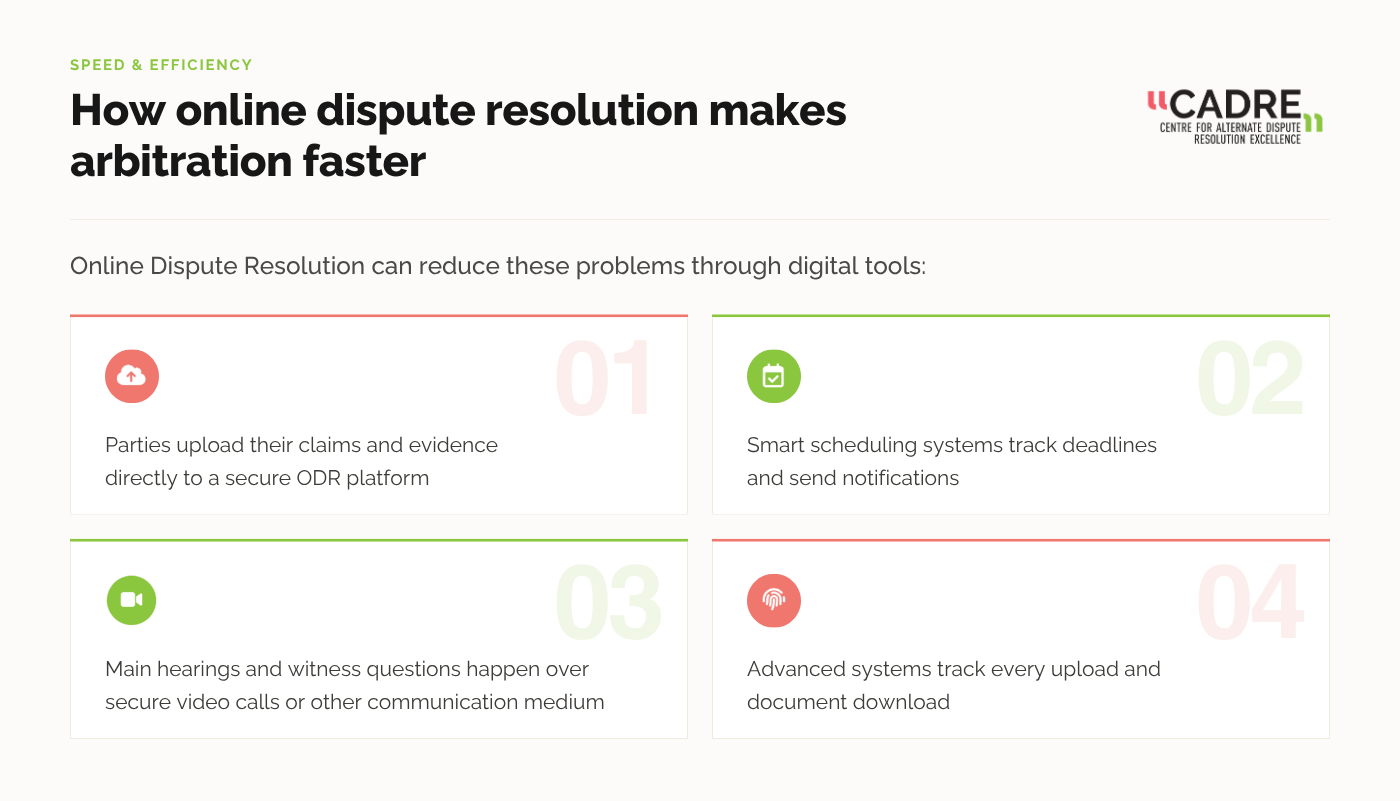
How online dispute resolution makes arbitration faster
Online Dispute Resolution can reduce these problems through digital tools:
- Parties upload their claims and evidence directly to a secure ODR platform
- Smart scheduling systems track deadlines and send notifications
- Main hearings and witness questions happen over secure video calls or other communication medium
- Advanced systems track every upload and document download
When adding an ODR clause, businesses should rely on an experienced provider. CADRE has processed thousands of disputes across banking, technology, employment, and commercial sectors.
An arbitration clause sample for your agreements
Select a precise template to resolve your disputes smoothly. Here is a template designed for your business needs:
The modern ODR clause template
Note: This is just a draft template. Please get your clause checked by an expert.
Clause [X]. Dispute Resolution and Online Arbitration
- The parties will first attempt to resolve any dispute arising out of or in connection with this Agreement through good-faith negotiation, and where agreed, mediation, within [X] days.
- Any dispute not so resolved shall be referred to and finally resolved by arbitration administered by CADRE in accordance with its arbitration rules in force at the time the arbitration is commenced, which are deemed incorporated into this clause.
- The tribunal shall consist of a sole arbitrator appointed in accordance with those rules. No party shall have unilateral control over the appointment.
- The arbitration may be conducted online where appropriate, while leaving the tribunal discretion to adopt a suitable procedure, including any oral or physical hearing it considers necessary.
- The seat of arbitration shall be [City], India. The venue or platform for hearings may differ from the seat and does not change it. The language shall be English.
- The substantive law governing this Agreement is the law of India.
- Arbitration is commenced by written notice served on the other party, and on the institution, at the address in this Agreement or as later notified.
- Nothing in this clause prevents a party from seeking interim relief from a competent court.
- The allocation of costs shall be determined in accordance with the applicable rules and Section 31A of the Arbitration and Conciliation Act, 1996. Any initial deposit shall be shared as the institution directs.
If an unpaid invoice or a contract breach threatens your revenue, using the CADRE clause might help both parties sit at the mediation or arbitration channel within typically 45 days.
A step-by-step guide on how to use the arbitration clause
A complete arbitration clause usually covers multiple components. To build a valid and legal clause, follow these 3 essential steps:
Step 1. Choose a sole arbitrator
For most commercial agreements, a sole arbitrator is faster and cheaper than a three-member panel.
Indian law also requires neutral appointment. In Central Organisation for Railway Electrification v. M/s ECI SPIC SMO MCML (JV), the Supreme Court held that one party cannot unilaterally appoint the arbitrator or control a curated panel.
This violates procedural equality under Section 18 of the Arbitration and Conciliation Act, 1996. To avoid this risk, appointments should be handled by an independent institution like CADRE, India’s simplest online dispute resolution platform.
Step 2. Pick the legal home known as the seat
The seat is the legal home of the arbitration and decides which court can supervise the case. For example, if Bengaluru is the seat, Bengaluru courts handle matters such as arbitrator appointment or award challenges. In online arbitration, a participant’s location on a video call is not the seat.
However, even in online arbitration, naming a physical city is strongly advisable. Without it, the clause is not automatically invalid, since Section 20 lets the tribunal fix the place. But leaving it open creates uncertainty over which court has authority.
In one such case of Versatile Construction v. Tata Motors Finance Ltd., the Calcutta High Court established that the named seat gives exclusive authority to that location’s courts.
Step 3. Define the language of the case
Name one language for all filings, emails, and hearings. This prevents delay tactics based on translation demands and keeps the process smooth. English is often the simplest choice for commercial agreements.
Using arbitration clauses and ODR
A clause is only as good as its drafting. Before drafting or signing, always verify your clause to ensure fair arbitrator selection, name a physical juridical seat, separate consumer elements, and incorporate institutional rules.
This compliant framework creates a secure operational safety net, helping you resolve commercial disputes quickly and privately without draining cash reserves.
Secure your next contract by choosing CADRE, India’s simplest online dispute resolution platform, to manage your institutional dispute workflows.
FAQs for arbitration clause
An example is a short contract section stating that any dispute will be resolved by binding arbitration under a dispute resolution platform, using a sole arbitrator, with English as the language and Bengaluru as the legal seat.
The five main types are domestic, international commercial, institutional, ad-hoc, and statutory arbitration. Modern commercial contracts increasingly favour institutional online dispute resolution for faster legally binding outcomes.
This clause requires a panel of three experts to resolve a dispute. Each party picks one arbitrator, and those two choose a third chairperson. While thorough, this setup is much slower and more expensive than a sole arbitrator.
Arbitration involves three distinct legal frameworks. These are the substantive law governing the main contract, the procedural law regulating the arbitration process itself, and the specific law governing the validity of the arbitration agreement.
The seat determines the legal jurisdiction and which specific court supervises the arbitration. The venue is merely the physical or digital location where hearings take place. Even if hearings happen online, the legal seat remains anchored to the city named in the contract.