TL;DR
Online dispute resolution (ODR) helps banks, NBFCs, lenders, MSMEs, enterprises, and individuals resolve unpaid invoices and commercial claims out of court.
CADRE, India’s simplest online dispute resolution platform, manages notices, evidence, negotiation, mediation, conciliation, and arbitration online for faster, enforceable recovery.
You can have groceries at your door in ten minutes, a cab in two, and a dinner bill split before the plates are cleared today.
Even so, if a client refuses to pay an outstanding invoice, the traditional resolution can stretch into years.
For an enterprise handling high-volume commercial transactions or a business struggling with capital allocation, waiting years for a resolution is no longer viable.
In this article, we’ll cover what ODR is, how an ODR platform works, and why online dispute resolution in India has moved from experiment to a working tool.
Key ODR facts at a glance
Here are some quick details about ODR:
| Category | Key details |
| Who uses ODR | Enterprises, banks, NBFCs, small businesses, digital platforms, and individuals |
| Common uses | Unpaid vendor invoices, loan defaults, supply chain claims, and contract breaches |
| Consent rules | Private ODR requires mutual consent (via contract clause or post-dispute submission)Statutory and regulatory schemes may mandate initial participation |
| Legal validity | Mediated settlements and arbitral awards are legally binding under Indian law when procedural requirements are met |
| Court role | Courts enforce awards, hear limited statutory challenges under Section 34, and resolve non-arbitrable matters |
What is ODR (and what is not)?
Online Dispute Resolution (ODR) is the use of internet-based tools, secure document sharing, and digital communication platforms to resolve conflicts without going to court.
ODR is not a single government court proceeding or informal chat. Instead, it’s supported by several recognised acts in India:
- A mediated settlement is binding under the Mediation Act, 2023
- An arbitral award is enforceable like a court decree under the Arbitration and Conciliation Act, 1996
ODR also covers a few legal models, such as:
- Private Consensual ODR
- Statutory ODR
- Regulatory ODR
- Court-Connected ODR
So, you’re not trading certainty for speed. ODR moves a dispute out of the courthouse without moving it out of the law.
How does an ODR platform work
An enterprise-grade ODR platform is fundamentally different from generic video conferencing software like Zoom or Microsoft Teams.
It functions as a secure, end-to-end digital environment designed to preserve confidentiality, manage evidence, and guide parties through structured resolution stages.
The digital workflow typically follows a clear, progressive lifecycle:
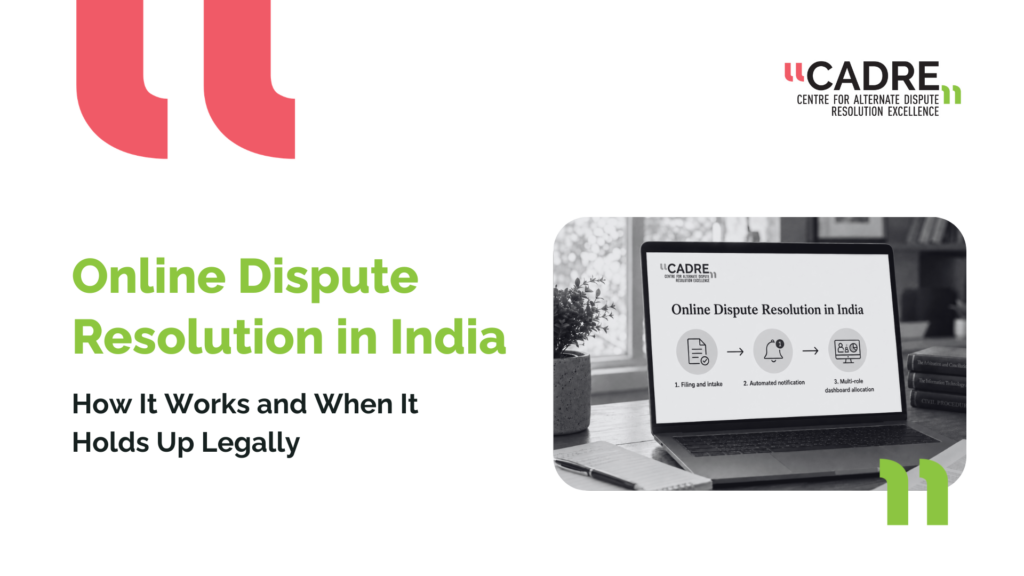
Filing and intake
The claimant initiates proceedings by uploading contract files, unpaid invoices, and relevant transaction details to the platform.
Advanced platforms use optical character recognition (OCR) to categorise evidence, extract transaction dates, and verify the identities of the disputing parties.
Automated notification
Once the case is registered, the platform dispatches automated, traceable legal intimations to the responding party.
These notifications are delivered via verified channels, including email, SMS, and WhatsApp, generating a digital delivery notice and timestamp to support legal proof of service.
If a respondent ignores a valid arbitration notice, the arbitrator can proceed ex parte under applicable rules after verifying delivery proof.
Multi-role dashboard allocation
Both parties receive access to specialised dashboards. The claimant monitors the progress of their claims, while the respondent can upload counter-claims, responses, or defence files.
Case managers use dedicated portals to track compliance with timelines and coordinate proceedings.
Resolution stages
The dispute moves sequentially through 4 distinct tiers:
- Automated Negotiation: The parties submit confidential settlement offers. The platform’s algorithm evaluates confidential submissions to identify overlapping ranges and record mutual agreements.
- Assisted Negotiation: If blind bidding fails, the parties engage in discussions facilitated by the platform’s communication tools.
- Online Mediation/Conciliation: If direct negotiations stall, an independent human neutral steps into a private digital room to help both sides find common ground.
- Online Arbitration: If conciliation fails, the matter is submitted to a qualified arbitrator. The arbitrator reviews the digital evidence and issues a binding decision.
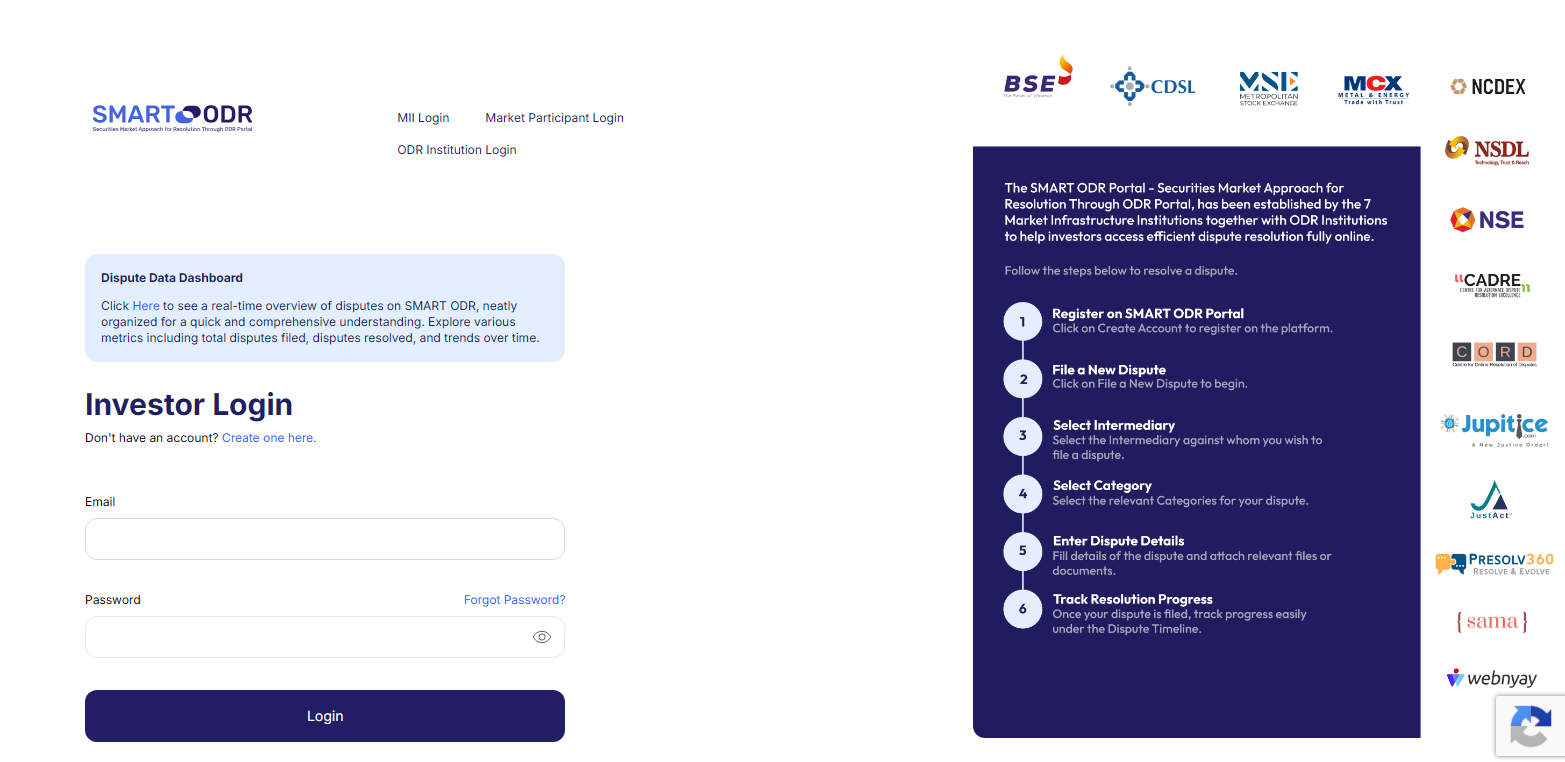
SEBI Smart ODR portal ensures this escalating logic of a pre-conciliation window of 21 days, followed by conciliation and arbitration respectively.
Timelines and cost drivers
- Speed: Private ODR routinely settles disputes within 30 to 90 days, with standard commercial cases averaging just 45 days.
- Cost efficiency: Fully remote, paperless environments eliminate courtroom travel and physical filing overhead.
At CADRE ODR, qualified human neutrals review and guide AI-assisted steps so that a qualified person makes every legal decision.
Which disputes are suitable for ODR (and which need court)?
Here are a few instances where ODR is better suited vs a traditional court:
| Category | Suitable for ODR | Better suited for courts |
| Evidence type | Document-heavy contracts, unpaid invoices, digital receipts | Complex physical evidence or extensive oral witness cross-examination |
| Claim nature | B2B payment defaults, loan recovery, service-level breaches | Urgent interim injunctions, asset freezes, criminal fraud |
| Legal scope | Commercial and arbitrable claims | Non-arbitrable matters (matrimonial, insolvency, land title) |
4 real-world use cases of private ODR systems
Online dispute resolution in India is an active administrative system, handling millions of cases across various economic sectors. These 4 real-world applications span public e-Lok Adalats, regulatory platforms, and enterprise implementations.
1. Institutional and regulatory deployments
In partnership with state legal services authorities, recognised ODR platforms have facilitated online Lok Adalats to resolve massive volumes of pending, pre-litigation, and petty cases. Historical data highlights the scale of these efforts:
- Delhi Online Lok Adalat: Resolved 5,838 disputes, resulting in settlements totalling over ₹46.2 crores.
- Rajasthan Online Lok Adalat: Utilised 351 virtual benches to settle 33,546 disputes, with a total settlement value exceeding ₹270 crores.
- Maharashtra Online Lok Adalats: Facilitated massive online dispute drives, resulting in more than 14 lakh settlements valued at ₹94 crores in a single cohort.
2. Enterprise ODR integrations
Digital lenders and e-commerce firms have adopted ODR to manage consumer grievances, debt recovery, and contract breaches. For example:
- Banking & NBFC recovery: ICICI Bank integrated alternative digital resolution modules to offer customers a remote, amicable method to resolve payment and service disputes.
- E-commerce resolution: Snapdeal integrated online conciliation mechanisms to process consumer disputes, successfully resolving over 50% of its filed consumer complaints within a 30-day window.
- Commercial disputes: Bajaj Markets resolved over 1,800 commercial disputes in 30 days using automated mediation, outperforming traditional physical dispute timelines.
3. CADRE’s impact on recovery for John Deere
Paper notices often fail because letters are lost, addresses change, or recipients cannot understand them. CADRE helped John Deere replace physical notices with outreach through SMS, WhatsApp, email, and phone calls.
- Digital communication resolved 5–7% of cases before arbitration concluded, with borrowers making direct payments
- Borrowers paid over ₹2.7 crore in withdrawn cases before full arbitration
- By reaching early settlements through CADRE’s engagement workflow, John Deere spent only about half of what full arbitration would have cost to win outright
4. Recovering overdue MSME invoices
MSMEs run on thin margins. When buyers stretch payment terms, it creates severe capital-related issues, disrupting operations.
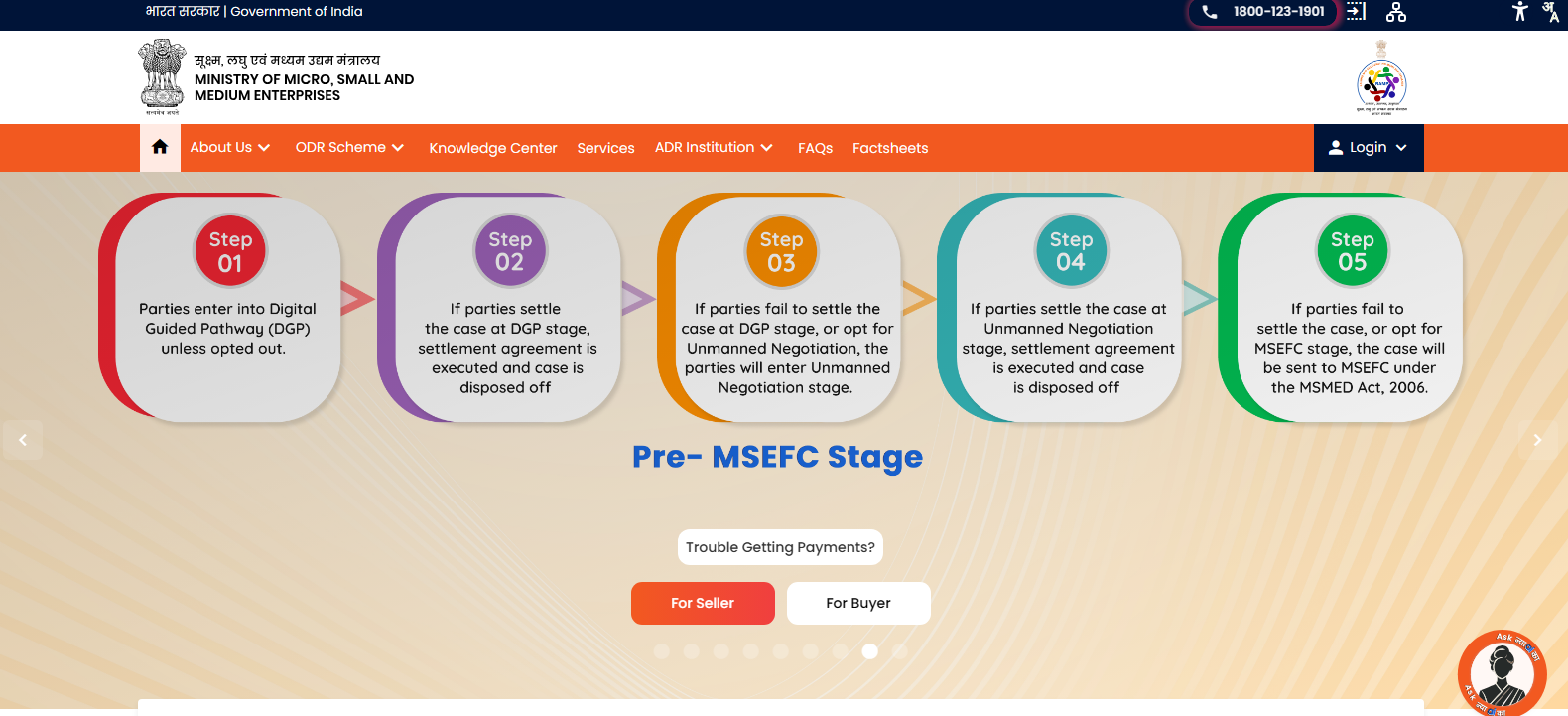
Since civil courts are too expensive for chasing small unpaid invoices, the MSME online infrastructure was established under the MSMED Act, 2006, to give small enterprises statutory leverage.
As of June 2026, fresh MSME delayed-payment applications are now directed to the MSME ODR Portal instead of the Samdhaan portal.
6 online dispute resolution benefits in India
The transition from physical courts to private ODR platforms offers several advantages for businesses, consumers, and public administration.
1. Faster resolution timelines
Traditional courts often require several years or even over a decade to resolve a single commercial matter due to severe caseload backlogs.
Private ODR platforms routinely settle disputes within 30 to 90 days, with standard commercial online dispute resolution cases in India averaging just 45 days.
2. Direct reductions in transaction costs
Physical litigation requires you to commit significant capital for frequent courtroom travel and administrative fees.
Digital platforms operate as fully remote, paperless environments, helping enterprises reduce aggregate dispute costs significantly.
3. Commercial privacy and information control
Court trials are matters of public record, exposing sensitive corporate friction and business structures.
ODR environments are highly private and access-controlled, protecting proprietary assets within secure virtual rooms.
4. Simplified and accessible interfaces
Traditional court proceedings are governed by local civil procedures that require intense administrative effort to navigate.
Modern ODR platforms use intuitive, conversational interfaces supported by automated guides and multilingual options to make the process straightforward.
5. Relationship-preserving outcomes
The court produces a winner and a loser, and the working relationship rarely survives the fight. That is a real cost when the other party is a supplier or client you still need next quarter.
ODR works differently. Mediation and assisted negotiation help both sides reach terms they can live with, so the commercial relationship stays intact.
6. Binding legal validity
While court decrees often face lengthy, multi-tiered appeal processes, the outcomes of private ODR offer equal legal certainty.
The process produces binding settlement agreements and arbitral awards that carry enforceability under the Arbitration and Conciliation Act, 1996.
This combination of swift timelines and legal enforceability is especially critical for India’s MSME ecosystem, where a single delayed invoice can threaten daily operations.
CADRE helps businesses utilize these benefits with secure digital workflows, trained human neutrals, and structured processes designed for legally sound online dispute resolution in India.
Challenges of online dispute resolution in India
ODR is faster and more accessible than litigation, but businesses should consider a few limitations:
- Digital access: Some parties may struggle with online dashboards, uploads, or virtual hearings.
- Data security: Platforms must protect contracts, invoices, and settlement communications with encryption and access control.
- Neutral quality: Fair outcomes depend on qualified, independent mediators, conciliators, and arbitrators. CADRE ensures fairness with certified neutral rosters and mandatory conflict-of-interest disclosures before appointment.
- Procedural compliance: ODR outcomes are enforceable only when notices, consent, documents, and award or settlement formalities follow the law.
Securing business cash flow through ODR
ODR platforms and MSME Samadhaan are reshaping commercial dispute resolution in India. Businesses can resolve claims remotely, while laws such as the Mediation Act, 2023 support enforceable outcomes.
If delayed payments or unfulfilled contracts are stalling your operations, CADRE provides a secure, streamlined path to a legally binding outcome.
FAQs on online dispute resolution in India
CADRE ODR is among India’s experienced private ODR providers, trusted by financial institutions, enterprises, and regulators for structured digital workflows, human neutrals, and legally binding resolutions.
The four types are negotiation, mediation, conciliation, and arbitration. The first three support mutual settlement, while arbitration involves a neutral issuing a final, binding decision.
Online Dispute Resolution (ODR) uses digital tools, secure dashboards, and internet technology to resolve disputes outside court, delivering faster and legally binding outcomes.
An MSME can use ODR to recover an unpaid invoice through remote mediation. SEBI’s SMART ODR Portal also resolves securities market grievances online.
For commercial claims, ODR reduces timelines, costs, and friction. It offers private, collaborative resolution while delivering outcomes with legal enforceability.
Yes, international commercial arbitration and mediation can be conducted online if parties agree on governing law, seat, and digital procedures.