TL;DR
When parties cannot agree, Section 11 of the Arbitration and Conciliation Act, 1996 lets the High Court (domestic) or Supreme Court (international) appoint an arbitrator after a Section 21 notice and 30-day default.
After CORE II (November 2024), a party with an interest in the dispute can no longer control who is appointed.
CADRE, India’s simplest online dispute resolution platform, provides independent institutional appointment workflows that comply fully with post-CORE II equal treatment rules.
Imagine two companies sign the same vendor contract on the same day, each allowing the larger party to appoint the sole arbitrator.
18 months later, when disputes arise, one appointment sails through, and the other is struck down before the first hearing, restarting the whole matter. The difference is a drafting choice the Supreme Court has now made unenforceable.
Sec 11 Arbitration Act, 1996 is the mechanism that appoints a tribunal when the parties’ own process fails. After CORE II (November 2024), it also marks the line that one-sided appointment clauses now cross.
This guide covers how appointments work today, and how to keep your clause on the right side of them.
This is general information about the law, not legal advice on a specific matter.
What is Section 11 of the Arbitration and Conciliation Act
Section 11 of the Arbitration and Conciliation Act, 1996 is the statutory backstop for constituting an arbitral tribunal when the parties’ own appointment process fails.
It lets a party apply to the competent court, the High Court for domestic arbitration, the Supreme Court for international commercial arbitration, to appoint the arbitrator.
Section 11 begins from party autonomy. A person of any nationality may act as arbitrator unless the parties agree otherwise (Section 11(1)), and the parties are free to agree their own procedure for appointment (Section 11(2)).
While that agreed procedure works, the court stays out. Section 11 engages only when the contract is silent, or the agreed mechanism breaks down.
| Provision | Subject | Timeline | Default |
| Section 11(1) | Nationality | – | Any nationality unless the parties restrict it |
| Section 11(2) | Party autonomy | As per contract | Parties free to agree any procedure |
| Sections 11(3) and 11(4) | Three-member tribunal | 30 days per stage | The court appoints, if a party or the two co-arbitrators default |
| Section 11(5) | Sole arbitrator | 30 days from request | The court appoints, if the parties cannot agree |
| Section 11(6) | Agreed procedure fails | As per contract | Engaged where a party, an arbitrator or an institution fails to perform its function |
How is an arbitrator appointed in India?
Arbitrators in India are appointed first through the parties’ own agreed procedure under Section 11(2) of the Arbitration and Conciliation Act, 1996.
Where the parties have not fixed a workable procedure, the Act supplies defaults:
- Three-arbitrator tribunal: Each party appoints one arbitrator within 30 days of a written request. The two appointees then choose the presiding arbitrator. If a party does not nominate, or the two cannot agree on the presiding arbitrator, the appointment of the arbitrator passes to the competent court on application.
- Sole arbitrator: If the parties cannot agree on a single name within 30 days of a request, the court appoints the sole arbitrator.
What the court looks at
Section 11(6A) confines the court at this stage to examining the existence of an arbitration agreement. Deeper questions, such as validity, arbitrability, and the scope of the clause, go to the tribunal under Section 16.
That provision is still in force, which surprises people. Section 3 of the 2019 amendment would have omitted Section 11(6A), but Section 3 was never notified, so some printed bare acts show it as deleted when it is not.
How long does it take a court to appoint an arbitrator under Section 11?
Section 11 cannot be invoked until a Section 21 notice has been served and the 30-day default period has lapsed.
Once the application is filed, Section 11(13) asks the court to endeavour to dispose of it within 60 days of notice to the other side, a target the Act sets to get a tribunal in place quickly.
The Section 21 notice also matters. Arbitration commences when the respondent receives a request to refer the dispute. Without proof that such a notice was served and that the other side then failed to appoint, a Section 11 application is premature and liable to be dismissed.
Jurisdiction turns on the type of arbitration (Section 11(12)). A domestic matter goes to the High Court within whose territory the principal civil court sits; an international commercial arbitration goes directly to the Supreme Court.
Institutional appointment and the 2019 gap
The 2019 amendment tried to move appointments out of the courts and into arbitral institutions appointments designated under Section 11(3A).
However, that shift has not been brought into force, so the High Courts and Supreme Court still appoint under Section 11 themselves (as at September 2026).
2 reforms shaped the current position:
- The 2015 amendment inserted Section 11(6A), confining the court at the appointment stage to a prima facie check on whether an arbitration agreement exists. It left deeper questions of validity and arbitrability to the tribunal under Section 16.
- The 2019 amendment went further, contemplating appointment by institutions graded by a new Arbitration Council of India, with Section 11(6A) to be omitted once that machinery was live.
The 2019 statute points towards institutional appointment, but until Section 11(3A) is notified, a Section 11 application still lands on a judge’s desk, not an institution’s.
This does not stop you from using an institution. It means the route runs through your contract rather than through the statute: if your clause names an institution as the appointing authority, that is what operates, and Section 11 never engages. Statutory institutional appointment is a different thing, and it does not exist yet.
Can one party appoint the arbitrator alone?
No, not where that party has an interest in the dispute.
Since the Constitution Bench decision in Central Organisation for Railway Electrification (CORE II) on 8 November 2024, a party with an interest is discouraged from appointing the sole arbitrator. They are also discouraged from forcing the other side to choose from a panel it alone curates.
Why one side cannot choose the judge
Arbitration works only if the tribunal is independent and impartial. Section 12(5), read with the Seventh Schedule, makes anyone whose relationship with a party or the dispute falls into listed categories ineligible to be appointed.
It’s a statutory expression of the old principle that no one should judge their own cause. Where one commercial party controls selection, that neutrality is compromised before the first hearing.
Why is unilateral appointment of an arbitrator invalid?
Unilateral appointment of an arbitrator is invalid because a tribunal must be independent and impartial. One-sided control of appointment compromises that before the first hearing.
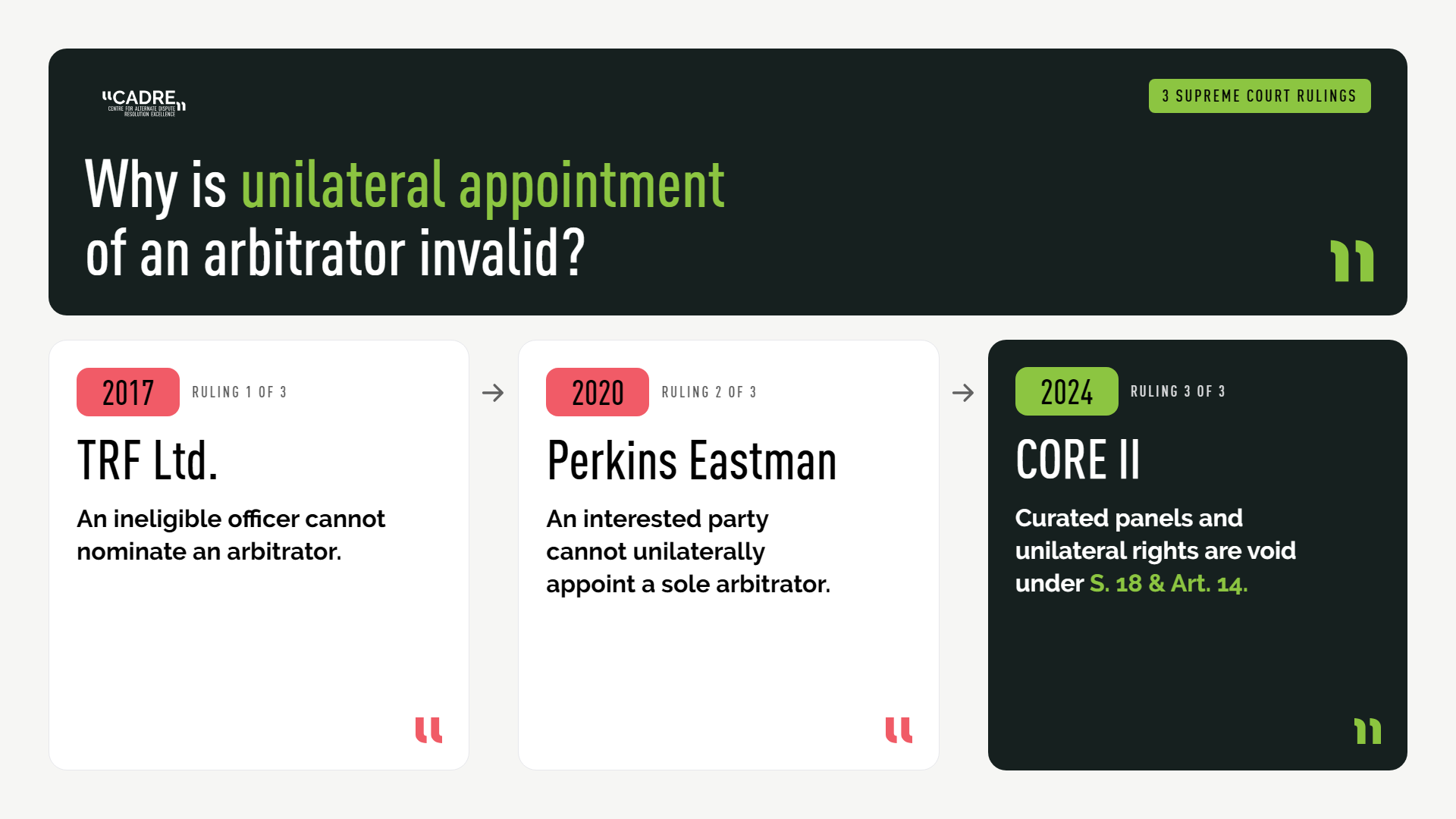
Judicial jurisprudence striking down the unilateral appointment of arbitrator mechanisms evolved through 4 decisions:
- TRF Ltd. v. Energo Engineering Projects Ltd. (2017): The Supreme Court established that an officer who is statutorily ineligible to act as an arbitrator under Section 12(5) (such as a Managing Director) also lacks the legal authority to nominate an arbitrator. An ineligible individual cannot delegate an appointment power they do not possess.
- Perkins Eastman Architects DPC v. HSCC (India) Ltd. (2020): The Court extended this principle to sole-arbitrator clauses, ruling that a party with a direct interest in the outcome of a dispute cannot unilaterally appoint a sole arbitrator, even if the appointing authority is not personally disqualified under the Seventh Schedule.
- CORE I (2019): A three-judge bench went the other way on panels. It held that Section 12(5) does not bar former employees from being appointed, and that a General Manager could appoint from a panel the railways curated, so long as the counterparty could nominate at least one name from that panel. A later three-judge bench in Union of India v. Tantia Constructions disagreed with it, and the question went to a larger bench.
- CORE II (8 November 2024, 2024 INSC 857): A 5-judge Constitution Bench of the Supreme Court resolved conflicting authorities by ruling that unilateral sole appointments and single-party curated panels in public-private contracts violate Section 18 equal treatment guarantees and Article 14 of the Constitution.
Does my existing contract’s arbitration clause still work?
CORE II applies prospectively. The Court directed, using Article 142, that its ruling governs arbitrator appointments made after the date of the judgment (8 November 2024), expressly so as not to disturb arbitrations and commercial arrangements already under way.
Redrafting dispute resolution clauses is a commercial advantage that speeds up contract execution by eliminating negotiation delays and preventing future pre-arbitral litigation.
Unsafe clauses to remove
- Clauses granting one party or its officer the unilateral right to appoint a sole arbitrator
- Clauses compelling a counterparty to select its nominee arbitrator from a panel curated exclusively by one side
- Clauses granting one party the right to veto or approve the opposing party’s nominee
Put these in
- Three-member tribunal structures: Each party independently nominates one co-arbitrator, and the two co-arbitrators jointly select a neutral presiding arbitrator.
- Institutional designation: Nominating an independent arbitral institution to act as the appointing authority if party agreement fails within 30 days.
- A sole arbitrator appointed jointly, with the court or the named institution appointing on default. A sole arbitrator is not the problem; one party choosing them is.
While the clause is open, two other things are worth fixing in the same pass:
- name the seat, which fixes the supervising court and which online arbitration makes a drafting choice rather than a geographic one
- set out how notices are to be served, since a defective Section 21 notice is what makes a Section 11 application premature
You can adapt sample arbitration clauses rather than drafting from scratch.
What the Draft Arbitration and Conciliation (Amendment) Bill, 2024 proposes
The Draft Arbitration and Conciliation (Amendment) Bill, 2024 proposes to accelerate institutional appointment pathways under Section 11. At the same time, it leaves the explicit prohibition of unilateral appointments to judicial precedent.
Published for public consultation by the Ministry of Law and Justice in October 2024 (formulated from the Dr T.K. Viswanathan Expert Committee recommendations), the Draft Bill introduces key procedural updates:
- Statute renaming: Shortening the principal statute’s title to the ‘Arbitration Act, 1996’.
- Institutional appointment push: Re-operationalising Section 11(3A) and Section 11(4) to route arbitral appointments directly through ACI-designated institutions.
- Emergency arbitrators: Providing statutory recognition for Emergency Arbitrators, granting their interim orders enforceability equivalent to tribunal orders under Section 17.
- Timeline enforcement: Establishing strict disposal windows for pre-arbitral applications under Sections 8 and 11 to cut judicial delay.
Notably, legal commentators highlight that the Draft Bill does not contain a dedicated statutory section explicitly banning unilateral appointments.
Instead, legislative drafters left the prohibition of unilateral appointments to be enforced through the constitutional framework established by CORE II.
Start with the clauses you already have
Pull your standard contracts now and replace any clause that lets one side appoint or curate the tribunal. Swap it for a three-member structure with a neutral presiding arbitrator, or name an independent ODR institution to appoint when the parties cannot agree.
It’s a fix that protects current and future matters from the challenge CORE II has made easy to raise.
CADRE, India’s simplest online dispute resolution platform, whose leadership presides over the ODR Association of India, administers that appointment so neither party holds the pen, while the courts keep their defined supervisory role.
FAQs on Section 11 Arbitration Act
There is no prescribed form. It follows the relevant High Court or Supreme Court rules. It sets out the parties, the arbitration agreement, and proof that the Section 21 notice was served. It also states that 30 days have lapsed without an appointment and includes a prayer to appoint the arbitrator, filed with the agreement, the notice, and a supporting affidavit.
Section 8 refers an existing court case to arbitration when one party sues despite an arbitration clause. Section 11 gets the arbitrator appointed when the parties’ own process fails. One diverts litigation; the other constitutes the tribunal.
No fixed person. Any nationality is allowed unless the parties agree otherwise (Section 11(1)); the court appoints a neutral, impartial arbitrator with the agreed qualifications. Anyone ineligible under Section 12(5) and the Seventh Schedule is barred, and after CORE II, an interested party cannot control the choice.