TL;DR
- The MSMED Act, 2006 gives registered micro and small enterprises 45 days to be paid, with compound interest at three times the RBI bank rate after that.
- Recovery runs through MSME Samadhaan, where the Facilitation Council conciliates and then arbitrates. It costs nothing to file and it is slow.
- Section 18 lets you use that route even if your contract contains an arbitration clause. The Supreme Court settled this in 2022.
CADRE, India’s simplest online dispute resolution platform, handles the dispute end-to-end, with 300+ neutrals on its panel and multilingual support. If a payment is stuck, it gives you a simple, secure path to a legally binding outcome.
For a small supplier, a delayed payment is more than an accounting entry. It ties up working capital, stalls the next order, and strains the business.
Many micro and small enterprises write these dues off, unsure of what the law allows. The MSMED Act, 2006 gives them an enforceable remedy: a right to timely payment, with interest once a buyer misses the deadline, and a statutory forum to enforce it. Recovery runs through the Facilitation Council under Section 18, or through arbitration or mediation outside it.
Parliament amended the Act in August 2026, and the amendment sharpens most of these tools.
This guide covers what counts as late, who qualifies, who is excluded, what the 2026 amendment changes, and which route fits your dispute.
This is general information about the law, not legal advice on a specific matter.
MSME payment recovery: What counts as late?
MSME payment recovery is how a registered micro or small enterprise collects debt that a buyer owes it for goods delivered or services completed. Under the MSMED Act, 2006, that recovery runs through a dedicated statutory channel, separate from an ordinary civil suit.
A payment is late once the buyer misses the deadline the Act sets, capped at 45 days from delivery. Once a buyer crosses it, three provisions decide what it now owes:
- Section 15 sets the payment deadline
- Section 16 charges compound interest from the day after the deadline passes
- Section 43B(h) of the Income-tax Act blocks the buyer’s tax deduction until the dues are cleared
What is the 45-day payment rule? (Section 15)
Section 15 sets the due date based on the day of acceptance rather than the invoice date.
Under Section 2(b), the day of acceptance is the day the buyer receives the goods or service. A written objection can move that date.
If the buyer objects in writing within 15 days of delivery, acceptance shifts to the day the supplier resolves that objection. But if no objection is made, the delivery date stands as deemed acceptance.
From that anchor, three timelines apply:
- With a written agreement, payment is due by the agreed date.
- With no agreement, payment is due within 15 days of acceptance.
- Even by agreement, the credit period cannot exceed 45 days from acceptance.
The third line is where buyers overreach. A purchase order promising 60 or 90 days holds no force. The law caps the credit period at 45 days, and the surplus is unenforceable.
The day after the deadline is the “appointed day.” Once the buyer crosses it without paying, the statutory consequences begin.
For example, take a delivery on 1 April with no written objection and no agreed date. Acceptance is 1 April, payment falls due by 16 April, and interest starts on 17 April.
How much interest does a late buyer owe?
From the appointed day, the buyer automatically owes interest for late payment to MSME vendors. Section 16 applies regardless of the contract, so a clause waiving or reducing interest has no effect.
The rate is three times the RBI bank rate, compounded monthly. At the bank rate of 5.50%, unchanged since December 2025, that is 16.50% a year nominal, and 17.81% once the monthly compounding is applied.
The table shows simple interest on a ₹10 lakh unpaid invoice at 16.50% a year:
| Time unpaid | Interest owed (compounded monthly) |
| 3 months | ₹41,820 |
| 6 months | ₹85,388 |
| 12 months | ₹1,78,068 |
Interest accrues until the buyer actually pays. A stalled ₹10 lakh due reaches ₹11.78 lakh in a year.
Section 23 of the MSMED Act adds one more cost. The buyer cannot claim this interest as a deduction under the Income-tax Act, so it lands as a net expense with no relief at assessment.
What did the MSMED (Amendment) Act, 2026 change?
Parliament passed the Micro, Small and Medium Enterprises Development (Amendment) Bill, 2026, the Rajya Sabha on 3 August 2026 and the Lok Sabha on 7 August 2026, and it received Presidential assent on 13 August 2026.
The Act’s provisions take effect from the dates the Central Government notifies, and as at the date of this article no commencement notification has been traced. Treat every change below as pending until the Gazette says otherwise, and check before you rely on one.
| What changed | Before | After the 2026 amendment | What it means for MSME industries |
| Dispute timeline | One ~90-day window to decide the reference | Fixed stages: mediation in 90 days, then arbitration referral in 30 days, then award in 90 days | A stalled case now faces hard deadlines at every step |
| Enforcing an award | Enforceable as an arbitral award under the 1996 Act | New Section 18A adds two routes: recovery as an arrear of land revenue through the District Collector, and recognition of the amount as a debt under the Insolvency and Bankruptcy Code, 2016 | Extra pressure points to make a non-paying buyer settle |
| Challenging an award | Buyer (challenger) deposits 75% to apply to set it aside | 75% deposit stays; if the challenge runs past 6 months, the court must release at least 50% of the award to you | You can access part of your money while the buyer litigates |
| Payments from large buyers | Companies with turnover above ₹250 crore and all CPSEs already have to be onboarded onto a TReDS platform (31 March 2025 deadline) | New Section 15A requires every Central Public Sector Enterprise to actually settle MSME invoices through an RBI-authorised TReDS platform, extendable to other notified entities | Onboarding becomes settlement, which is the part that affects when you get paid |
| Online resolution | Not in the statute | Central Govt may run mediation and arbitration by video and electronic means | Pursue a claim without travelling to the council |
| Penalties | Court-imposed fines on conviction | Graded administrative penalties, starting with a warning, decided by the Development Commissioner with a right of appeal | Administrative action rather than prosecution |
Which businesses are protected under the delayed-payment provisions?
The MSME Act payment terms apply only to registered micro and small enterprises that fall within these limits, updated on 1 April 2025.
| Category | Investment up to | Turnover up to | Covered by the delayed-payment provisions? |
| Micro | ₹2.5 crore | ₹10 crore | Yes |
| Small | ₹25 crore | ₹100 crore | Yes |
| Medium | ₹125 crore | ₹500 crore | No |
The enterprise must also hold a valid Udyam registration, and the dues must relate to a completed supply of goods or services.
Two more conditions apply. The dues must relate to a completed supply of goods or services. Registration timing also matters, since courts expect the enterprise to be registered when the contract is formed, not only when the dispute surfaces.
When you were registered decides whether you are covered
Registration timing is the issue that defeats more claims than any other, and the Supreme Court has ruled on it twice.
In M/s Silpi Industries v. Kerala State Road Transport Corporation (2021), the Court held that an enterprise must have been registered at the time of supply to claim the benefit of the delayed-payment provisions, so a registration taken out later does not reach back over earlier transactions.
In Gujarat State Civil Supplies Corporation v. Mahakali Foods (2022), the Court put it by reference to the contract: a party that was not a “supplier” within Section 2(n) on the date of entering into the contract cannot claim the benefit of that status, and a later registration operates prospectively.
Who is excluded
- Medium enterprises: Section 2(n) defines a “supplier” as a micro or small enterprise, so Sections 15 to 18 do not reach a medium enterprise at all. It can still arbitrate or mediate, which is covered below.
- Traders: Retail and wholesale trades were brought onto the Udyam portal by an Office Memorandum of 2 July 2021, and a further Office Memorandum confirmed that traders may access priority sector lending only, with “any other benefits, including provisions of delayed payments as per MSMED Act, 2006” expressly excluded.
Samadhaan, arbitration or mediation: Which route fits your dispute?
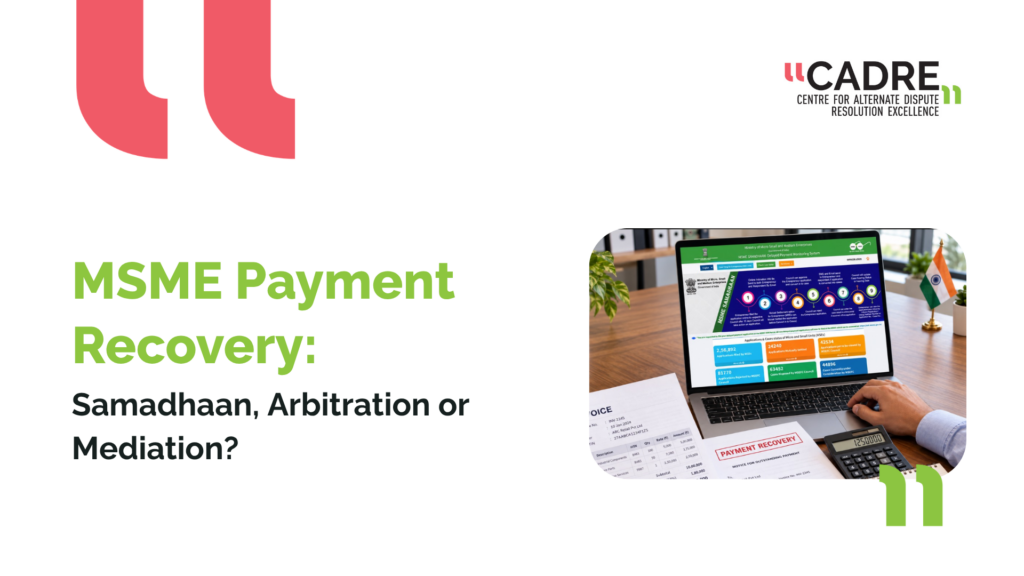
MSME Samadhaan is the statutory route for MSME payment recovery online. A registered enterprise files the claim on the portal, and the case moves to the State MSEFC.
The council first attempts conciliation between the buyer and supplier. If that fails, the same council acts as arbitrator and issues a binding award under Section 18, MSMED Act.
- Conciliation: The council helps the buyer and supplier reach a deal but can’t impose one, so it works only if the buyer takes part. Any settlement reached binds both sides.
(The Act earlier called this stage “conciliation”; the 2026 amendment reframes it as mediation under the Mediation Act, 2023, but it’s not in force yet.)
- Arbitration: If mediation fails, the council decides the claim and issues a binding award, enforceable like a court decree. Once the 2026 amendment is in force, it can also be recovered as land-revenue arrears.
Where Samadhaan helps and where it does not
What it does well
- Costs nothing to file, so a small business is not priced out.
- Needs no arbitration clause or prior legal notice to begin.
- Carries statutory interest at three times the bank rate, applied automatically.
- Ends in a binding award or settlement, enforceable at law.
- Cannot be excluded by an arbitration clause in the supply contract.
Where it falls short
- You cannot choose the path; the forum runs mediation first, and moves to arbitration only if it fails.
- Open only to micro and small enterprises, so medium firms and traders are shut out.
- Slow in practice, held up by heavy council backlogs.
- A favourable award still needs a separate execution step if the buyer refuses to pay.
- The 2026 amendment promises fixes like fixed timelines and stronger recovery, but they aren’t in force yet.
ODR platforms for MSME delayed payment: A faster alternative
A micro or small business runs on thin cash reserves. When a buyer misses the deadline, the supplier delays its own vendors, EMIs, and salaries to stay afloat.
An independent online dispute resolution platform removes that wait. You get an enforceable outcome in a fraction of the time and cost, without the council backlog that slows Samadhaan.
The positives of ODR platforms
- Open to medium enterprises and traders, who have no access to Samadhaan at all. For them this is the main route rather than an alternative to one.
- Suppliers choose arbitration, mediation, or conciliation, rather than a fixed statutory sequence.
- Proceedings stay confidential, so a working relationship with the buyer can survive the dispute.
- Everything runs online and multilingual, with the case tracked in real time from filing to award.
The limitations it comes with
- A filing fee applies, unlike the free Samadhaan route.
- It needs either an arbitration agreement or a buyer willing to participate. Without one of those, a micro or small supplier is better off at the council, which can proceed without the buyer’s consent.
- It does not carry Section 16 interest automatically. Statutory interest is a creature of the MSMED Act, so where the claim is brought outside that Act the interest has to be claimed and established on the contract.
The final takeaway: Which is the right route for MSME payment recovery?
When the buyer denies the debt or goes silent, MSME Samadhaan is the natural first move. Filing costs almost nothing, and it doesn’t require the buyer’s cooperation.
Samadhaan falls short for many, though. It is open only to micro and small enterprises, and it moves slowly, wasting time for both sides and increasing recovery costs.
A third-party platform is the better pick when the buyer will engage, and you want speed and privacy the council cannot offer. It opens the same route faster and more securely, taking the load off both your team and the buyer.
CADRE India’s simplest online dispute resolution platform handles the process end-to-end, from document filing to automated reminders. That keeps it smooth for both sides, so you focus on the business and the relationship.
FAQs for MSME payment recovery
Micro and small enterprises can file the claim on the MSME Samadhaan portal, which routes it to the State MSEFC. The council first attempts conciliation, then moves to arbitration if that fails, and its award is binding.
Mediation and online dispute resolution offer a faster, cheaper path when the buyer engages. Statutory interest under Section 16 of the MSMED Act applies throughout.
An MSME dispute is a commercial disagreement involving a micro, small, or medium enterprise. Most cases concern delayed or unpaid dues for goods or services already supplied. Some involve contract terms, quality, or service failures.
Under the MSMED Act, 2006, the MSEFC handles delayed-payment disputes between a micro or small supplier and its buyer.
The buyer becomes liable from the appointed day, whether or not the contract mentions interest. Section 16 sets compound interest at three times the RBI-notified bank rate for delayed payment to MSME vendors, compounded monthly.
The supplier can then file on MSME Samadhaan to recover the dues with that interest. Under Section 43B(h) of the Income-tax Act, the buyer also loses the expense deduction until it pays.
An affidavit is needed only when the purchase order was oral, not written. It is a notarised declaration confirming the oral work order and its key terms, such as parties, value, and date. The portal does not publish a single prescribed statutory format.
Draft it on non-judicial stamp paper, have it sworn before a notary, and attach it as a PDF under 1 MB.
Open the MSME Samadhaan portal and select the entrepreneur or MSE units tab. Enter your Udyam or Udyog Aadhaar number, then verify with the OTP sent to your registered mobile or email.
Upload the disputed work orders and invoices, up to three of each, with every file under 1 MB. Submit the application; the MSEFC then issues a notice to the buyer and starts conciliation. A prior legal notice is not mandatory.