
📌 TL;DR
RBI guidelines for loan recovery set firm boundaries on how lenders and their agents pursue overdue payments. Contact is restricted to daytime hours, with no threats, public shaming, or approaching a borrower’s family.
Agents must carry proper certification and identification, and lenders remain accountable for their conduct.
When a recovery dispute still needs resolving, CADRE, India’s simplest online dispute resolution platform, settles it faster, without court delays, through a legally binding process both sides can trust.
Loan recovery is a demanding process for both lenders and borrowers. Lenders must collect what they are owed without crossing legal boundaries, while borrowers often face pressure during financially stressful times.
Without clear limits, recovery can tip into harassment, leaving both sides worse off.
To protect the interests of both sides, the RBI has implemented specific guidelines for loan recovery. This governance keeps the process fair, transparent, and accountable.
In this blog, we cover the RBI guidelines for loan recovery, the recovery process, and the best practices lenders and borrowers can follow to handle it smoothly.
What are RBI guidelines for loan recovery?
RBI loan recovery rules are designed to keep recovery fair, transparent, and ethical. They are built around a few key areas, including fair collection, harassment prevention, agent conduct, and borrower privacy.
1. Fair collection practices
The Fair Practices Code requires lenders to deal clearly with borrowers at every stage of the loan.
- Lenders must give borrowers due notice before handing an account to a recovery agent
- The borrower must be told the agent’s identity before any contact begins
- Disputed dues should be resolved through the lender’s grievance process, not through pressure
2. Harassment prevention
The 2022 circular sets clear limits against loan recovery agent harassment. It includes the fact that the lender remains responsible for an agent’s conduct, even when collection is outsourced.
- No use of threats, abusive language, or physical force against a borrower
- No publicly shaming a borrower or disclosing the default to people around them
- No persistent or repeated calls made to pressure or wear down a borrower
3. Communication boundaries
The loan recovery rules determine when and how a borrower can be contacted, which helps to protect their privacy and peace of mind at home.
- Calls and visits are allowed only between 8:00 a.m. and 7:00 p.m
- Agents cannot contact a borrower at odd or inconvenient hours
- A borrower’s family, neighbours, or colleagues cannot be approached about the dues
4. Agent training and accountability
Recovery agents are not free agents. The RBI guidelines for loan recovery agents, set out in 2007 and 2008, require them to be trained and properly authorised.
- Agents should complete certification, usually through the Indian Institute of Banking and Finance or a linked institute
- Each agent must carry a valid ID and a letter of authorisation from the lender
- Lenders must run a grievance redressal mechanism that borrowers can reach
5. Digital and app-based loans
The RBI (Digital Lending) Directions, 2025, which came into force on 8 May 2025, tighten the rules governing how online lenders and their service providers can recover dues.
- The lender is fully responsible for any service provider it engages to recover a loan
- The app can collect only the data the loan needs, and only with consent
- Repayments go to the lender’s bank account, never an app or agent, which curbs fraud
- Cash on a defaulted loan is credited to the borrower’s account the same day
RBI’s new guidelines for loan recovery
The RBI issued draft directions on recovery conduct in February 2026, then revised them in May 2026. While the draft is yet under consideration, it points towards the following changes:
- A written, board-approved recovery policy that every lender must follow
- Compulsory certification and training for all recovery agents
- Audio recording of recovery calls, kept on file
- Stricter limits on borrower data and on contacting a borrower’s family or contacts
Until there is an official notification, the existing circulars continue to apply as they stand.
What is the process of loan recovery?
The loan recovery process matters to both sides for different reasons. Borrowers can use it to spot the moment a lender or agent crosses the line. Lenders rely on it to keep a debt recovery loan moving forward while staying within conduct norms.
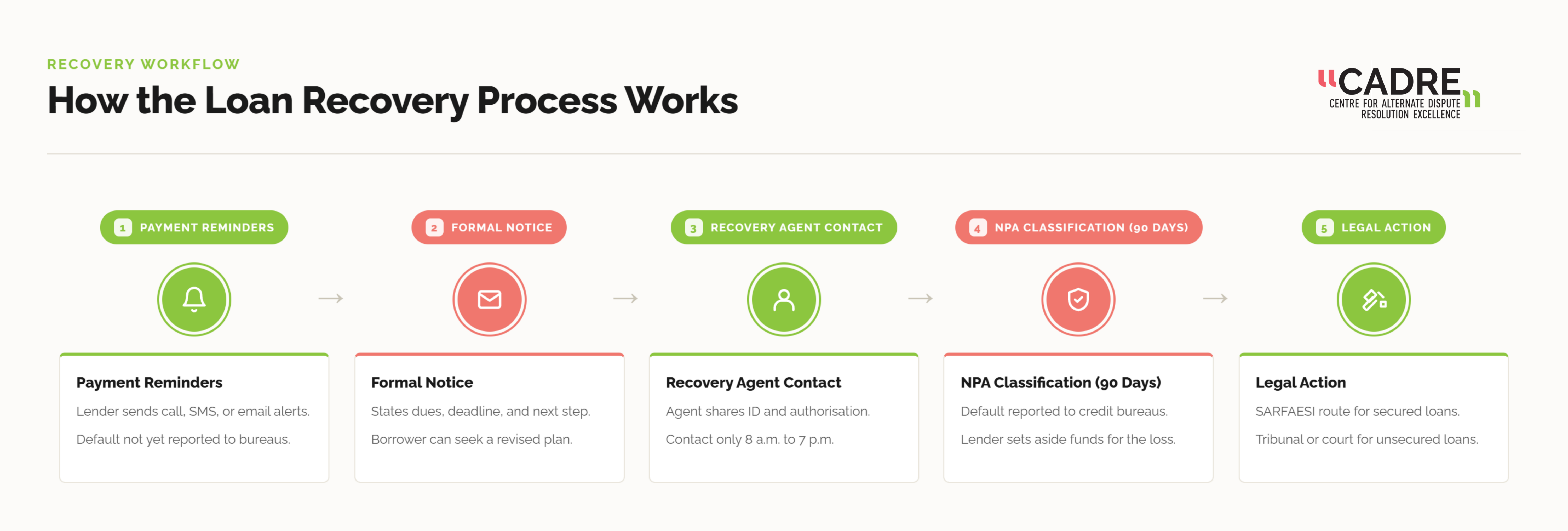
The process usually moves through these stages:
1. Payment reminders
When a borrower misses a few EMIs, the lender sends reminders by call, SMS, or email. At this stage, the default has not yet been reported, so clearing dues or flagging a genuine hardship can prevent it from going further.
2. Formal notice
If dues stay unpaid, the lender serves a written notice. It states the total overdue amount with interest and penalties, the deadline to clear it, and the action the lender may take next.
Borrowers can reply in writing and request restructuring, a longer tenure, or a revised EMI on the grounds of hardship.
3. Recovery agent contact
If the account stays overdue, the lender assigns the matter to a loan recovery agent and shares the agent’s details with the borrower. The agent may then visit or call between 8 a.m. and 7 p.m., carrying a valid ID and a letter of authorisation from the lender.
4. NPA classification
For most loans, the account becomes a Non-Performing Asset after 90 days of non-payment. Once it does, three things follow:
- The default is reported to credit bureaus
- The lender sets aside funds against the loss
- Recovery proceeds to firmer steps, such as settlement or legal action
5. Legal action
The route depends on the loan type. Secured loans, such as home or vehicle loans, allow the lender to enforce the security under the SARFAESI Act, 2002, after due notice.
For unsecured loans, such as personal loans, the lender must instead file a case before a Debt Recovery Tribunal or a civil court.
However, these routes have their own limitations. SARFAESI has strict eligibility criteria, and the others are slow, tiring, and expensive. This has pushed many lenders and borrowers toward faster, less adversarial, digital ways to settle disputes.
What can lenders do to stay compliant during loan recovery?
The easiest way to avoid penalties and reputational harm is to follow the RBI guidelines for loan recovery closely. The lender remains answerable for every agent acting on its behalf.
A few practices keep the loan recovery process compliant and defensible:
- Run due diligence on any recovery agency before engaging it, and verify that its agents hold valid certifications
- Train recovery agents on conduct rules, calling hours, and what counts as harassment, so the line is never crossed
- Keep records of recovery contact, and run a grievance mechanism that borrowers can actually reach
Beyond conduct, lenders can rethink the recovery route itself. Courts are slow and costly for small-ticket defaults, so it helps to use routes that resolve disputes faster and suit both sides.
- Lok Adalat: A forum that settles disputes by mutual consent, with an award that is final and binding. It works well for straightforward, lower-value defaults where both sides want closure.
- Mediation: A neutral mediator helps the parties reach a voluntary agreement. It suits cases where the lender wants to preserve the customer relationship.
- Conciliation: Similar to mediation, but the conciliator can suggest terms of settlement. It fits disputes where the parties need more active guidance to agree.
Best practices for borrowers during the loan recovery process
Recovery is easier to handle when a borrower acts early and knows what to expect. A few steps can keep the situation under control and limit damage to a credit score.
- Communicate on time: Respond promptly to reminders and notices, and if you are facing financial trouble, tell your lender. This protects your credibility and helps you agree on a plan suited to your situation.
- Know your rights: Be clear on what recovery can and cannot involve. An agent cannot misbehave, threaten, or coerce you, and if one does, you have the right to report it.
- Explore repayment options: If the current EMI is unworkable, ask about restructuring, a longer tenure, or a one-time settlement. Lenders often prefer a revised plan to a long recovery fight.
- Keep a record: Note the dates, names, and content of every call or visit, and save messages. This strengthens your case if you escalate to the grievance officer or the RBI Ombudsman.
Follow the right way to recover and resolve!
When both borrowers and lenders understand the RBI guidelines for loan recovery, the process runs smoothly, fairly, and without either side losing time or trust. It shields borrowers from harassment and lenders from penalties and loss of trust.
Where a dispute does arise, online dispute resolution offers a hassle-free route. Both sides reach a binding outcome without the cost of court or the strain of a drawn-out recovery.
CADRE (India’s simplest online dispute resolution platform) brings deep authority in this space, with end-to-end arbitration, mediation, and conciliation. From filing to final award, it supports both parties through a faster, fairer resolution.
FAQs on loan recovery
A bank has 3 years from the date you default before it can take you to court. After that, it usually cannot sue to recover the loan. This clock restarts if you make a payment or admit the debt in writing.
Borrowers can complain first to the lender’s grievance officer, then escalate to the RBI Integrated Ombudsman. For threats or assault, you can also file a police complaint.
Loan default is a civil matter, not a crime, so police have no role in routine recovery. They step in only if there is a separate criminal act, such as fraud, threats, or assault.
Default itself is not a jailable offence at SBI or any lender. Jail risk arises only in linked criminal cases, such as a bounced cheque under Section 138 of the Negotiable Instruments Act.
A default stays on your credit report for seven years from the date of the last default, then drops off on its own. It does not erase the debt itself, only the record on the report.