
TL;DR
An arbitration clause lets a landlord and tenant resolve disputes through a neutral arbitrator instead of a civil court.
It works for tenancies governed by the Transfer of Property Act. CADRE, India’s simplest online dispute resolution platform, administers this process online and is one of the ODR institutions empanelled under SEBI’s SMART ODR framework.
A dispute over an unpaid month’s rent or a withheld deposit rarely looks serious at the start. Then it reaches a civil court, and a small disagreement becomes a multi-year wait.
For a landlord, a co-working operator, or a business leasing office space, that delay ties up money and attention the dispute was never worth. Tenants carry the same cost from the other side.
Court litigation remains essential for many matters, but a routine rent dispute is often not one of them.
In this article, we’ll explore how an arbitration clause in a rent agreement is an effective way to protect both sides from long delays and how online dispute resolution can make the process faster and more accessible.
How a dispute resolution clause arbitration works
An arbitration clause lets a landlord and tenant agree, in advance, to resolve disputes through a neutral arbitrator instead of a civil court. The arbitrator’s decision, called an arbitral award, is binding on both sides. Here’s how it works:
A lease is not a leave-and-licence. A lease transfers an interest in the property to the tenant for a term. A leave-and-licence only permits to occupy, with no interest transferred. Both are casually called “rent agreements,” but the law treats them differently.
Shifting from a judge to a neutral arbitrator
The arbitrator is not just a private expert. They are a neutral decision-maker whose authority comes from your agreement and the Arbitration and Conciliation Act, 1996.
Appointment is not always “both sides pick one.” Parties may agree on a method, an institution may appoint, or a court may step in under Section 11 if the parties cannot agree.
Once the award is made, it is final and binding under Section 35. Under Section 36, it is enforced in the same manner as a court decree, once the time for a Section 34 challenge has expired. If a challenge is filed, enforcement is not automatically stayed. The court must grant a stay on a separate application.
An award is binding, but it is not beyond review. A losing party can still challenge it under Section 34 on limited grounds. Speed does not come at the cost of a fair process.
Online dispute resolution (ODR) provides this institutional framework by administering the case from filing to award, rather than functioning only as a portal for online hearings.
A clause that names an institution sets the appointment method and the timeline before any dispute arises.
Supreme Court judgments on arbitration clause in rent agreement
Most landlord-tenant disputes can go to arbitration. The main exception is premises governed by state rent-control laws.
The ruling of the Vidya Drolia case
In Vidya Drolia v. Durga Trading Corporation (2020), the Supreme Court ruled that landlord-tenant disputes governed by the Transfer of Property Act, 1882 are arbitrable. Since lease arguments are private matters between individuals, they do not need to take up public court time.
When arbitration is legally barred
The Court drew one clear line. Properties under state Rent Control Acts cannot use arbitration and must go to public rent tribunals.
So the question is not whether your dispute is a rent dispute. It is whether your tenancy falls inside your state’s rent control statute.
Most do not. State rent acts typically apply only below modest rent thresholds. The Karnataka Rent Act, 1999, for instance, does not apply where rent exceeds ₹3,500 a month in corporation areas or ₹2,000 elsewhere.
A tenancy at market rent in a metro is therefore usually governed by the Transfer of Property Act, 1882, which is exactly where an arbitration clause is valid and enforceable.
Check your state’s threshold and exemptions before you rely on the clause.
Confused if this is the right category of dispute to file? Check out our guide on the different types of disputes and what you should do in which scenario.
Legal implications of an arbitration clause in a contract
Including an arbitration clause ensures speed, strict privacy, and long-term safety for both owners and tenants. The clause stays active even after the lease ends to handle financial claims or eviction issues.
Get registration and stamp duty right first. Under Section 107 of the Transfer of Property Act, 1882 and Section 17 of the Registration Act, 1908, a lease from year to year, for a term over one year, or reserving a yearly rent can be made only by a registered instrument. The agreement must also be stamped under the applicable stamp law, which varies by state.
What the clause actually changes
When you add an arbitration clause, the legal implications of the arbitration clause in rent agreement management change in your favour, such as:
- Timeline: Section 29A requires an award within 12 months of the completion of pleadings, extendable by six months with the parties’ consent. A civil suit carries no equivalent outer limit.
- Privacy: Arbitral proceedings are confidential under Section 42A, subject to the exception for disclosure necessary to enforce or challenge an award. Any Section 34 or Section 36 proceeding becomes a public court record.
- Appointment: Naming an institution means the arbitrator is appointed under its rules, without a Section 11 application to court.
Why the clause stays valid after the lease ends
The clause remains valid even if the lease expires. For example, if a tenant refuses to leave a co-working space after the contract ends, the owner can still use the clause to get a binding award in their favour.
Hidden pitfalls in traditional arbitration and the online dispute resolution fix
The right alternative dispute resolution mechanism can significantly affect the time, cost, and effort involved in resolving a rental dispute.
| Factor | Court | Traditional arbitration | ODR through CADRE |
| Time | 2–5+ years | 6–18 months | 30–90 days |
| Cost | Legal fees and repeated appearances | Arbitrator, venue, and legal fees | Structured, transparent pricing |
| Process | Formal filings and hearings | Multiple-party coordination | Fully online |
| Appointment | Not applicable | May require a Section 11 of the Arbitration and Conciliation Act, 1996 | Institutionally managed |
| Best suited for | Matters requiring judicial intervention | Complex, high-value disputes | Routine rental and payment disputes |
Modern online dispute resolution platforms remove many of these barriers by standardizing appointments and communications digitally.
An arbitration clause template for online dispute resolution
A strong arbitration clause in agreement India should name an institutional platform directly, so timelines are set and the appointment method is clear. This helps keep the process paperless, fast, and legally compliant.
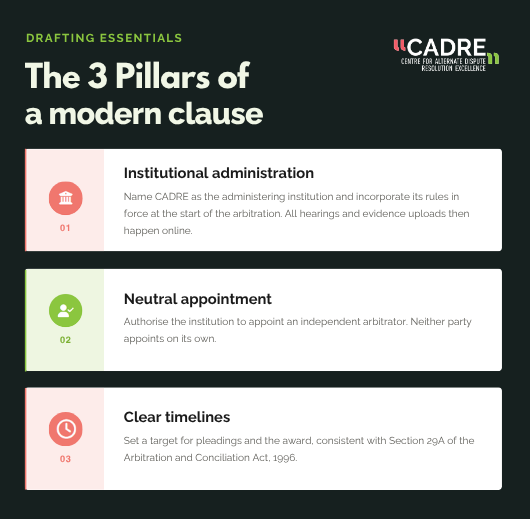
Here is a template to adapt with counsel:
| Any dispute arising out of or in connection with this rent agreement, including its existence, validity, breach, or ending, shall first be referred to good-faith negotiation. If it is not resolved within [30] days, it shall be finally resolved by arbitration administered by CADRE under its arbitration rules in force at the start of the arbitration, which rules are treated as part of this clause. The tribunal shall be a sole arbitrator appointed under those rules. Neither party may appoint the arbitrator on its own. The seat of arbitration shall be [city, State]; where a hearing is held online or elsewhere, that place is the venue only and does not change the seat. This agreement is governed by the law of India. Nothing in this clause stops either party from applying to a competent court for interim relief under Section 9 of the Act. Notices shall be served by [email/portal] to the addresses in this agreement. Costs shall be decided by the tribunal under Section 31A of the Act. |
Making your rent agreement dispute-ready
Before you sign, confirm three things:
- Tenancy sits outside your state’s rent control statute
- Agreement is registered and stamped where required
- Clause names an institution rather than leaving appointment to chance
An arbitration clause is only as strong as the process behind it. If you manage rental income across a portfolio, or lease commercial space, the clause you sign decides how the next dispute runs.
CADRE, India’s simplest online dispute resolution platform, has helped shape ODR practice in India. If you manage rental income across a portfolio, or lease commercial space, the clause you sign decides how quickly you recover.
FAQs for arbitration clause in rent agreement
Clause 10 states that parties can choose the number of arbitrators, but it cannot be an even number.
Where the clause names an institution, the institution appoints the arbitrator under its rules, so no Section 11 application to court is needed. If a party then stays away, the tribunal proceeds and may make an award, and a failure to file a defence is not treated as an admission under Section 25.
For a tenancy outside state rent control, an arbitrator can generally grant eviction and possession relief, since these disputes are arbitrable. Enforcing possession still goes through the court under Section 36. Where the property falls under a state rent control Act, eviction must go to the forum that Act names.
Yes. Both parties can add an arbitration clause after signing by executing a mutually agreed amendment or supplementary agreement. The clause generally applies to disputes that arise after it is added.
Notices are typically served through agreed digital channels, such as email or CADRE’s online platform. The arbitration clause should specify the accepted mode of communication to avoid service disputes.
Rent, escalation, security deposit and deduction heads, term, notice period, maintenance responsibility, and a dispute-resolution clause. Get registration and stamping right, since an unregistered lease that required registration creates problems well beyond dispute resolution.
Arbitration is a private, formal mechanism where a neutral expert resolves rental disputes outside court through a binding decision.