TL;DR
Domestic arbitration runs on a roughly eighteen-month statutory clock, while commercial suits can take years.
Litigation has lower entry costs but uncertain long-run costs, whereas arbitration costs more upfront but can close sooner.
A court passes a decree, and a valid arbitral award is final, binding and enforced like a decree, subject to limited challenge.
For a fast, binding solution, companies use CADRE, which administers arbitration online and is one of the ODR institutions empanelled under SEBI’s SMART ODR framework.
When an Indian business contract fails, frozen cash flow and slow operations threaten business continuity.
To protect reputation and balance sheets, enterprises must choose between traditional court litigation and private arbitration for conflict resolution.
Arbitration is a private system in which parties submit their dispute to neutral, independent experts (arbitrators) rather than a government judge.
In this article, we’ll look at how arbitration vs litigation compare, and which option is faster, cheaper, and binding in India.
Quick comparison: Arbitration vs litigation
| Factor | Litigation | Arbitration |
| Forum | Public courts run by the state | Private tribunal chosen under an arbitration agreement |
| Procedure | Governed by the CPC and evidence law | Flexible; not bound by the CPC or formal evidence rules in the same way |
| Decision-maker | Judge assigned by the court | One or more arbitrators, often with industry expertise |
| Confidentiality | Generally public | Typically confidential for the arbitrator, institution and parties |
| Court’s role | Court decides the case | Court supports and supervises |
| Outcome | Decree | Award, enforced like a decree, subject to limited challenge |
The legal structure of arbitration vs litigation in India
Litigation takes place in public civil courts run by the state. Arbitration is a private process managed by independent arbitrators, supported and supervised by the courts at defined stages.
What is litigation?
Civil lawsuits in India are managed by the judiciary. They follow the strict rules of the Code of Civil Procedure, 1908, and the Bharatiya Sakshya Adhiniyam, 2023.
The process moves through fixed stages. It starts with formal complaints and summons. Then it moves to trials, witness cross-examinations, and final arguments.
However, not every case goes to a full trial and may end through settlements, withdrawals, and other procedures.
The Commercial Courts Act, 2015 established Commercial Courts and Commercial Divisions for qualifying specific disputes.
It also requires pre-institution mediation under Section 12A. Even so, the system remains public, adversarial and heavily crowded.
What is arbitration?
Arbitration is a private system governed by the Arbitration and Conciliation Act, 1996 and remains supported by courts at defined stages. This is a form of alternative dispute resolution that aims to resolve legal disputes outside public courtrooms.
It rests on a valid arbitration agreement, which must be in writing under Section 7. That can be a clause in the contract, or a separate agreement signed after a dispute arises. Under Section 19 the tribunal is not bound by the CPC or the Evidence Act.
An award is final and binding under Section 35. Under Section 36 it is enforced in the same manner as if it were a decree of the court, once the time for a Section 34 challenge has expired.
When arbitration is not available
Before comparing the two, check whether you have a choice at all.
- No agreement, no arbitration: Without a clause, arbitration requires the other side to agree in writing after the dispute has arisen. A party with the stronger delay position rarely agrees. If your contract is silent, litigation is your route.
- Not every dispute is arbitrable: Criminal matters, matrimonial disputes, insolvency and winding-up, and tenancies governed by rent control legislation that names a specific forum are not arbitrable. Consumer claims sit outside as well, since an arbitration clause cannot displace the consumer forum.
Key differences between arbitration and litigation
2 main structural pillars separate these choices:
- Section 42A of the Arbitration and Conciliation Act places a confidentiality mandate for specific stakeholders. This generally keeps sensitive business data safe, unless necessary for enforcement.
- Parties can select an arbitrator with relevant industry knowledge. A commercial tenancy dispute involving a co-working operator can go to someone who understands escalation clauses from day one.
For example, a commercial tenancy dispute involving a co-working operator can be assigned to a real estate expert who understands complex escalation clauses from day one.
Arbitration vs litigation: Pros and cons for businesses
Arbitration is usually faster but can be costlier upfront. Litigation has lower initial court fees but often becomes expensive over time because cases continue for years.
Which process resolves disputes faster?
Arbitration is preferred for speed because the Arbitration and Conciliation Act sets clear timelines:
- Pleadings: Completed within 6 months from the date the arbitrator, or all arbitrators, receive written notice of appointment (Section 23(4)).
- Final award: Domestic arbitration must be delivered within 12 months after pleadings close under Section 29A(1), creating an eighteen-month framework.
- Extensions: Parties may extend the timeline by 6 months. Further extension requires approval of the competent court under the Act.
- Delay control: On an extension application, the court’s endeavour is to decide within 60 days, and while extending it may reduce arbitrator fees by up to 5% for each month of delay where the tribunal caused it.
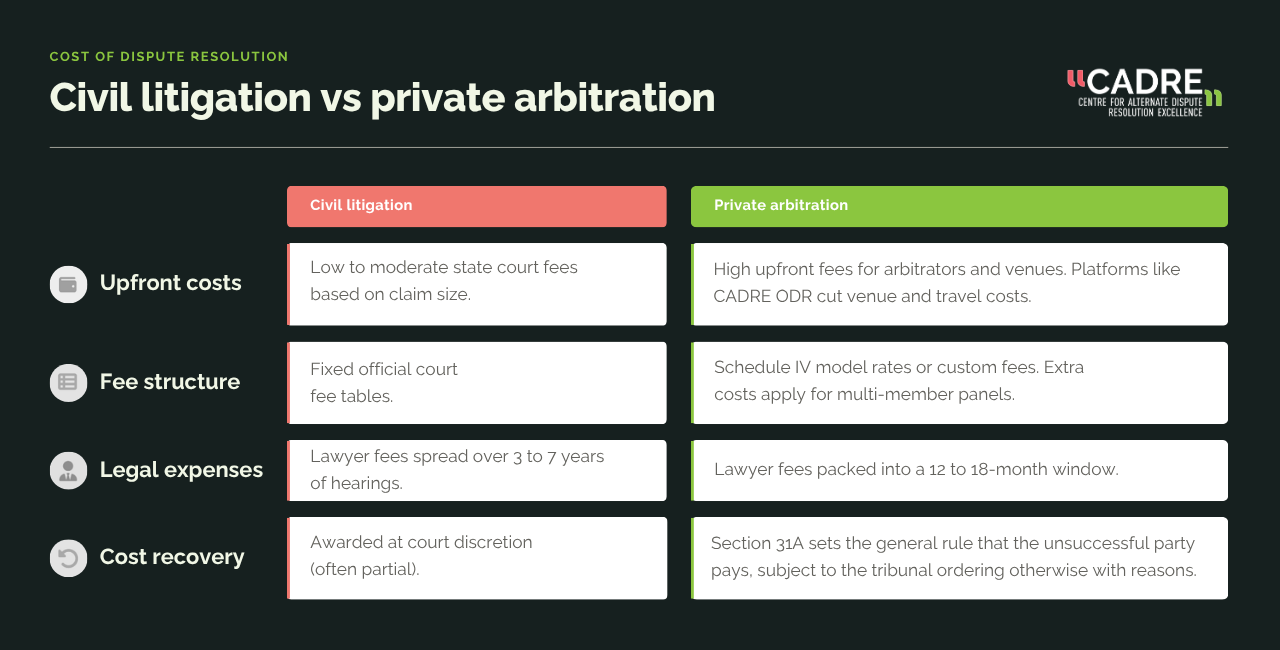
Civil litigation is usually slower due to court congestion. Commercial suits can take 3 to 7 years or more, especially with appeals. Arbitration may also stall if parties challenge appointments or file repeated interim applications.
If you are a tenant or landlord, check out our guide on the arbitration clause in a rent agreement that will help you make your contracts foolproof.
Which option is cheaper in the long run?
Litigation has lower initial court fees, but costs build up over the years. Private arbitration needs higher upfront money, but its shorter timeline keeps total costs predictable.
Is arbitration truly binding in India?
An award is final and binding under Section 35 and enforced as if it were a decree. It is not identical to a court judgment: it is subject to challenge under Section 34 and to appeal from that order under Section 37.
Courts are nevertheless tightly constrained. Section 5 limits judicial intervention, and courts cannot reappreciate evidence.
Grounds for challenging an award (Section 34)
An arbitral award cannot be appealed on its factual merits merely because a party disagrees with the arbitrator’s findings. Courts can only set aside an award under Section 34 on limited statutory grounds, including:
- Incapacity of a party or invalidity of the arbitration agreement
- Inadequate notice or inability to present a case
- Decisions beyond the scope of the dispute submitted
- Improper tribunal composition or procedural non-compliance
- Non-arbitrable subject matter or conflict with public policy
- Patent illegality (applicable to domestic arbitrations where the illegality goes to the root of the matter, without re-appreciating evidence or correcting a mere legal error)
Under Section 34(2A), patent illegality is confined to cases where the arbitrator ignores clear contract terms (Indian Oil, 2022) or adopts an irrational interpretation (Ssangyong, 2019). It does not extend to reappreciating evidence or correcting an error of law.
Note: Under Section 36(2), filing a Section 34 challenge does not automatically stop enforcement. The challenging party must file a separate application and obtain a stay order from the court, which often requires depositing security.
Roadmap for dispute management
Businesses, depending on the clause, can manage disputes through mediation, online dispute resolution for small claims, and full arbitration for large, complex matters.
A smart dispute strategy for choosing between arbitration vs litigation in India matches the forum to the economic weight and nature of the dispute.
CADRE (India’s simplest online dispute resolution platform) combines qualified, independent neutrals with secure technology.
FAQs for arbitration vs litigation
It depends on your goals. Arbitration provides faster timelines, privacy, and industry-specialist judges, whereas litigation has lower upfront fees but suffers from massive court backlogs.
Settlement can save time and preserve relationships when both parties are willing to compromise. Arbitration may be necessary when the parties need a binding determination and cannot agree on settlement terms.
Yes. Section 19 gives the tribunal procedural flexibility, and an arbitration can run entirely through digital filings, virtual hearings and electronic signatures. Keep the seat stated in the clause, since an online hearing is a venue and does not change the seat.