
TL;DR
Co-founder dispute resolution in India depends on your structure, company, LLP or partnership firm. Most founder fights are 2 disputes at once: a contract claim you can arbitrate, and a statutory claim you cannot.
Resolving them requires clear contractual repurchase rights, compliance with corporate statutes, and structured negotiation.
When internal talks fail, CADRE, India’s simplest online dispute resolution platform, can offer legally binding dispute resolution outside court.
Two Indian entrepreneurs launch a tech venture with equal enthusiasm. Two years in, a strategic rift over reinvesting profits versus drawing salaries halts decision-making.
Relying on a standard Articles of Association template without a custom shareholders’ agreement, neither founder has a legal tie-breaker.
Leadership deadlocks drive early-stage venture distress in India. Resolving co-founder friction requires understanding how Indian contract, corporate, and arbitration laws govern partner rights before deadlocks destroy enterprise value.
Keep reading to find the causes of co-founder conflicts, how to resolve them, and ways to protect your startup under Indian law.
6 main reasons for co-founder conflict in early-stage startups
Co-founder friction in Indian startups usually stems from unwritten commercial expectations, asymmetrical capital contributions, and informal governance arrangements created at incorporation.
While generic commentary attributes startup breakups to vague personality clashes, Indian founder disputes typically originate from 6 specific structural gaps:
- Missing foundational documentation: Companies incorporated using standard-form Articles of Association off a filing agent’s template, with no executed founders’ agreement or shareholders’ agreement (SHA).
- Capital versus sweat equity asymmetry: One partner contributes capital (e.g. ₹15 lakh) while the other contributes 18 months of unremunerated labour, with no written agreement defining how that converts to equity.
- Salary asymmetry: One founder draws a monthly salary while the other draws nothing due to personal savings or family support, creating unspoken operational resentment over time.
- Unrecorded external commitments: A co-founder maintaining a parallel job or consulting practice during the first year without formal disclosure or non-compete documentation.
- Informal cap table influence: Capital provided by family members or personal contacts who hold informal equity expectations and demand board-level decision input.
- Unassigned intellectual property: Software code, designs, or domain names created prior to incorporation that remain in an individual founder’s name rather than formally assigned to the company entity.
5-step plan for startup conflict resolution
Resolving leadership deadlocks requires structured role calibration, pre-institution mediation, and updating corporate filings to reflect settled terms.
When internal discussions reach an impasse, founders should execute a structured 5-step resolution plan:
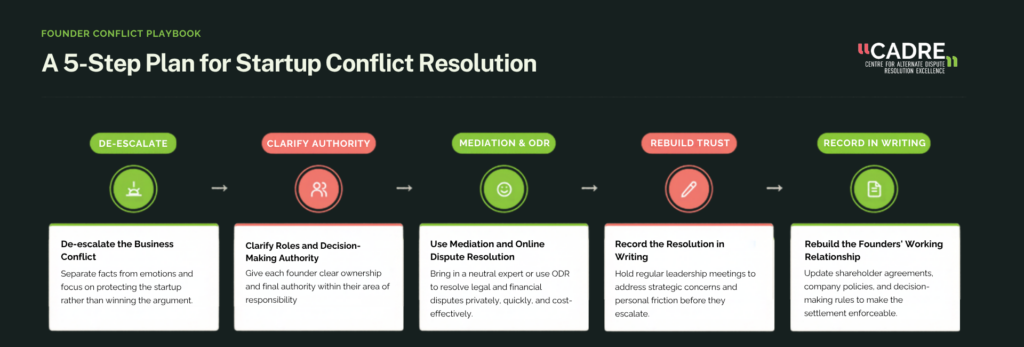
Step 1: Conduct an outcome-alignment exercise
Rather than debating abstract growth strategies, each founder separately writes down their specific three-year expectations across 4 variables: financial return, operational control, exit horizon, and daily responsibilities.
Swapping these documents reveals whether the disagreement is an operational dispute or a fundamental divergence in long-term goals. Most deadlocks that present as strategy fights are two people who stopped wanting the same outcome and never said so.
Step 2: Clarify founder roles and decision-making authority
Consensus decision-making works during initial ideation but creates gridlock during scaling.
Assign binding, single-point authority to specific partners over defined operational domains, such as product architecture or commercial sales.
Step 3: Use mediation and online dispute resolution
Section 12A of the Commercial Courts Act, 2015 mandates pre-institution mediation for commercial suits of ₹3 lakh or more that do not contemplate urgent interim relief.
Founders can resolve these through online dispute resolution (ODR) platform CADRE, using structured mediation or private arbitration.
Private arbitration operates outside open court litigation, while Indian courts maintain defined supervisory oversight under the Act for interim measures (Section 9), arbitrator appointments (Section 11), setting aside awards (Section 34), and enforcement (Section 36).
Two features of Section 12A make it less of an obstacle than it looks. The mediation must be completed in three months, extendable by two months with consent.
And under Section 12A(5), a settlement reached there has the same status and effect as an arbitral award on agreed terms under Section 30(4) of the 1996 Act, which makes it enforceable as a decree.
Step 4: Rebuild the founders’ working relationship
Set up regular meetings focused purely on leadership health and strategy. Keep these meetings separate from daily task updates to catch personal friction early.
Step 5: Record the resolution in writing
Verbal promises do not bind corporate entities. Once a dispute is settled, the terms must be formally executed and filed across statutory registers:
- Private Limited Companies: Passing a special resolution and filing Form MGT-14 with the Registrar of Companies (RoC) to amend the Articles of Association.
- LLPs: Executing a supplementary agreement and filing Form 3 with the RoC within 30 days.
- Partnership Firms: Executing a revised partnership deed and intimating the Registrar of Firms.
Pre-institution mediation under Section 12A of the Commercial Courts Act, 2015 is a mandatory statutory prerequisite before filing a commercial suit. Utilising alternative dispute resolution options in India fulfils this legal requirement without incurring multi-year court litigation delays.
Resolving conflict among business partners under Indian law
The legal path to resolving founder friction depends strictly on whether the business operates as a Private Limited company, a Limited Liability Partnership (LLP), or an unregistered partnership firm.
Private Limited Companies (Pvt Ltd)
Under the Companies Act, 2013, share transfer rules in a shareholders’ agreement must align with the Articles of Association to bind the company.
The proviso to Section 58(2) of the Companies Act, 2013 recognises contracts respecting security transfers as enforceable. It aligns with the shareholders’ agreement; the AoA remains essential to prevent enforcement failure during a dispute.
Because Indian law forbids cancelling paid-up shares, reverse vesting operates as a contractual call option to buy back unvested shares at a nominal price.
Limited Liability Partnerships (LLP)
Under Section 23(4) read with Item 14 of the First Schedule to the LLP Act, 2008, if an LLP agreement lacks a dispute clause, disputes between partners are referred to arbitration under the Arbitration and Conciliation Act, 1996.
Partnership Firms
Section 69 of the Indian Partnership Act, 1932 bars a partner of an unregistered firm from suing the firm or a co-partner in court to enforce a right arising from the partnership contract.
However, an arbitration clause in the partnership deed remains enforceable. Without a written deed, partners must seek dissolution in court under Section 44.
Watch out:
Unvested founder shares cannot be forfeited. They must be repurchased using a contractual call option at nominal value to comply with capital maintenance rules under the Companies Act, 2013.
The statutory boundary between arbitrable claims and NCLT petitions
Contractual disputes under a shareholders’ agreement can be arbitrated, but statutory claims of oppression and mismanagement fall exclusively under the National Company Law Tribunal (NCLT).
- Oppression and mismanagement (Sections 241–242): These petitions are non-arbitrable and belong to the National Company Law Tribunal. The Court did carve out one exception: a petition that is mala fide, vexatious or merely “dressed up” to escape an arbitration clause can still be sent to arbitration.
- The Section 244 threshold: A member needs at least one-tenth of the issued share capital, or one-tenth of the total members (or 100 members, whichever is less), to file an NCLT petition, unless the Tribunal grants a discretionary waiver.
- Contractual arbitration via electronic agreements: Governance deadlocks and SHA breaches remain arbitrable. Under Section 7(4)(b) of the Arbitration and Conciliation Act, 1996, an arbitration agreement can be validly established even through WhatsApp texts or emails.
The clauses that decide how a founder exit goes
- Shotgun and founder buyout clauses: One founder offers to buy out another at a set valuation. The partner receiving the offer must either accept it or buy out the offering founder at that exact price.
- Tag-along and drag-along rights: Tag-along rights protect minority owners during a share sale, while drag-along rights prevent individual partners from blocking acquisition deals.
- Arbitration and online dispute resolution clauses: Under Section 7 of the Arbitration and Conciliation Act, 1996, arbitration agreements can be established through clear contract clauses or written communications.
Every one of these binds the company only if it is reflected in the Articles. Agreeing them in the SHA alone is half the job.
How to carry out a clean co-founder separation
A legally sound co-founder separation requires executing specific statutory filings, exercising share repurchase options, and signing mutual deeds of release.
When reconciliation fails, executing a clean separation requires adherence to formal statutory compliance across entity types:
| Entity type | Mandatory statutory separation steps | Regulatory filings required |
| Private limited | Resignation/Removal of Director (Section 169) Execution of Share Transfer (Form SH-4) Payment of applicable stamp duty Board Resolution updating Register of Members | Form DIR-11 (by resigning director) Form DIR-12 (by company within 30 days) Form MGT-14 (for AoA amendment) Intimation to bank account signatories |
| LLP | Notice of cessation as Designated Partner Execution of capital contribution settlement Execution of amended LLP Agreement | Form 4 (Notice of cessation) Form 3 (Amended LLP Agreement within 30 days) |
| Partnership firm | Execution of Retirement Deed Settlement of partner capital account Public notice in the Official Gazette & local newspaper | Intimation to Registrar of Firms (if registered) Public notice to discharge third-party liability |
Legal releases and non-compete enforceability
Departing founders should execute a mutual deed of release discharging all parties from future contractual claims.
Under Section 27 of the Indian Contract Act, 1872, post-exit non-compete clauses prohibiting a lawful trade are generally void and unenforceable, though reasonable non-solicitation and confidentiality obligations remain valid.
Redistributing operational responsibilities across continuing leadership better preserves stability than attempting to operate alone.
Prevent future co-founder conflicts
Protecting startups from leadership gridlock requires embedding institutional arbitration into governance contracts before conflict arises.
Aligning shareholders’ agreements with company Articles and adopting online dispute resolution offers a confidential, time-bound path to resolution.
Under Section 35, an award is final and binding. Under Section 36, after the Section 34 challenge timeline expires, it is enforced in the same manner as a court decree.
When disagreements stall your growth, CADRE, India’s simplest online dispute resolution platform, provides a fast, private way to reach a legally binding outcome outside of court.
FAQs for co-founder conflict
Statutory default rules apply. Private Limited companies follow their Articles of Association. For LLPs, Schedule 1 of the LLP Act, 2008 mandates arbitration automatically. For unregistered firms, Section 69 of the Indian Partnership Act, 1932 prevents court suits, but written arbitration clauses remain enforceable.
Yes. Contractual SHA and partnership disputes are arbitrable under Section 7 of the Arbitration and Conciliation Act, 1996, including email agreements. CADRE resolves these outside court. However, oppression and mismanagement claims under Sections 241 and 242 of the Companies Act, 2013 belong exclusively to the NCLT.
Section 69 of the Indian Partnership Act, 1932 prevents partners of unregistered firms from suing in civil court. However, an arbitration clause in the deed remains enforceable. Partners can also seek court dissolution under Section 69(3)(a).
A co-founder can be removed as a director under Section 169 of the Companies Act, 2013 using an ordinary resolution. However, director removal does not forfeit shares. Majority shareholders cannot force an equity transfer without a contractual call option in a shareholders’ agreement.
Indian law forbids cancelling paid-up shares. Instead, reverse vesting operates as a contractual repurchase right: when a founder leaves, the company or continuing partners hold a call option to buy back unvested shares at a nominal price.