TL;DR
Litigation vs mediation is not a contest between right and wrong routes. Litigation delivers a binding judgment. Mediation delivers a negotiated settlement that courts can enforce.
Indian law lets parties move a pending dispute into settlement talks at almost any stage. For most commercial suits, mediation is a precondition for filing.
CADRE, India’s simplest online dispute resolution platform, runs that process end-to-end.
A commercial dispute stops being a legal question quickly. It becomes a working capital question. Money sits locked in a file while the business plans around it.
The cost is measurable. DAKSH’s Access to Justice Survey found civil litigants spend ₹497 a day attending hearings. They lose another ₹844 a day in wages and business time.
Most disputes do not need a ruling. They need a resolution both sides will honour. CADRE has run that shift for banks, NBFCs and MSMEs since 2019.
This guide covers what Indian law permits and how to move a pending dispute into settlement talks.
Litigation vs mediation: 7 core differences
Both routes bring a dispute to an end. They differ on who decides the outcome and how long that takes.
Litigation produces a judgment the state will enforce. Mediation produces an agreement designed by the parties themselves. That single distinction drives everything else, from cost and speed to privacy.
Seven differences matter most in a commercial dispute.
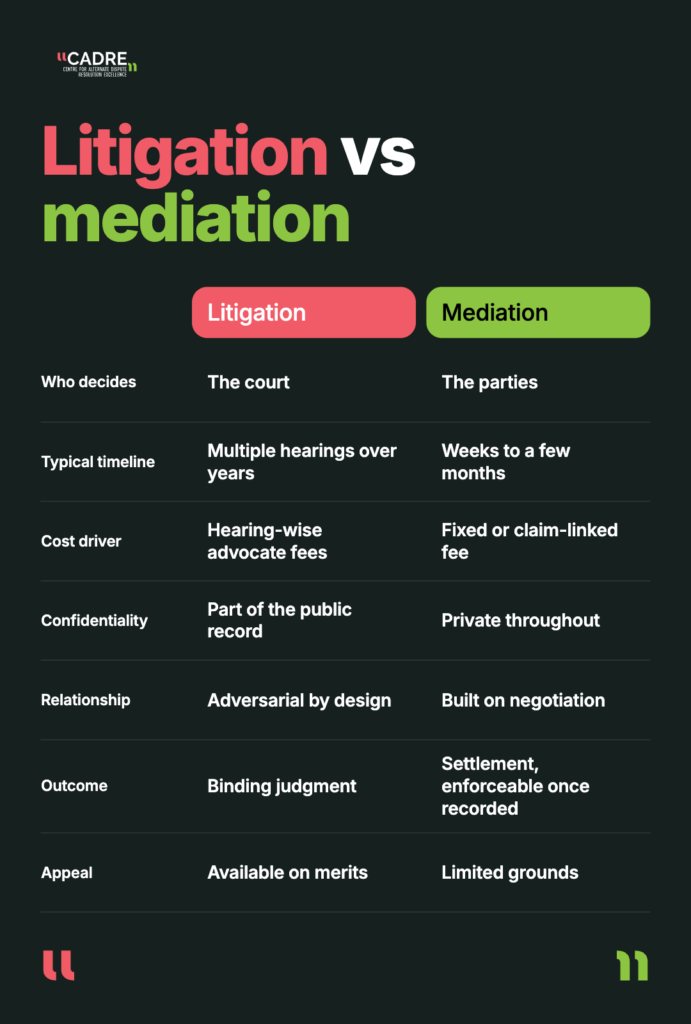
The practical difference shows up in cash flow. A judgment settles the legal position, but recovery often runs through a separate enforcement process. That gap is where working capital sits – and it is the same gap that makes recovering money owed to you in India a longer exercise than winning the argument.
What Indian law says about mediation
Mediation is one form of alternative dispute resolution recognised under Indian law, and courts can direct parties towards it. Three provisions do most of the work.
Section 89 of the Code of Civil Procedure, 1908
A civil court may refer a pending dispute to mediation where settlement looks possible.
In Afcons Infrastructure v. Cherian Varkey Construction (2010), the Supreme Court drew an important line. Arbitration requires the consent of both parties. Mediation does not. A reluctant opponent cannot block a referral.
Section 12A of the Commercial Courts Act, 2015
Commercial suits valued at ₹3 lakh or more require pre-institution mediation, unless urgent interim relief is sought.
Patil Automation v. Rakheja Engineers (2022) held the provision mandatory. M/s Dhanbad Fuels v. Union of India (2025) then drew the finer line: Section 12A has been mandatory since its insertion, but the consequence of rejecting a plaint for non-compliance applies only to suits instituted on or after 20 August 2022, the date of Patil Automation.
Two features of Section 12A are worth knowing before you treat it as an obstacle:
- The mediation must be completed within three months of the plaintiff’s application, extendable by two months with consent.
- A settlement reached under Section 12A has the same status and effect as an arbitral award on agreed terms under Section 30(4) of the Arbitration and Conciliation Act, 1996, which makes it enforceable as a decree under Section 36.
The Mediation Act, 2023
India’s first dedicated mediation statute covers settlement agreements, timelines, confidentiality and online mediation. It is being brought into force in stages, and much of its operative machinery, including the enforcement provision, has not yet been commenced. Until it is, the routes above are what give a settlement teeth.
How to move a pending dispute into settlement talks
A filed matter is not a closed door. Indian procedure allows a shift into negotiation almost any time before judgment.
What matters is doing it in order, so the settlement holds. Five steps take a dispute into structured talks.
- Check Section 12A before filing. Commercial suits valued at ₹3 lakh or more generally require pre-institution mediation unless genuine urgent interim relief is needed. Courts examine the claimed urgency rather than accepting the label alone.
- Apply for referral under Section 89. The natural moment is once pleadings close, before issues are framed. Either side may apply, and the court can act on its own.
- Agree the process. Fix the neutral, the format and a completion date upfront. Written terms of reference stop the timeline drifting.
- Run the sessions. Most matters need two or three. The neutral narrows the issues rather than ruling on them.
- Record the settlement. A court-referred settlement is recorded as a consent decree under Order XXIII Rule 3 of the CPC.
The suit does not disappear while settlement talks are underway. It pauses, and returns to the list if the settlement fails. Nothing said in the sessions carries over.
CADRE keeps every notice, session record, and settlement term in one auditable file.
Costs, limitations, and confidentiality
Three practical points decide whether a settlement route saves you anything. Each catches businesses out.
Check these before you commit.
- Limitation usually keeps running: The Limitation Act, 1963 allows three years for most contractual claims, though the trigger date depends on the type of debt. Informal settlement talks do not stop that clock.
- Court fee refunds vary by state. In Sanjeevkumar Kankariya v. Union of India (2024), the Supreme Court held that Lok Adalat awards and mediation settlements rest on different statutory footings for refund purposes, and that court fees are a State subject. What you get back depends on your state’s court fees legislation.
- Confidentiality is protected. In Moti Ram v. Ashok Kumar (2011), the Supreme Court held that a mediator reports only the settlement, or that talks failed.
Advocate fees remain the largest variable. They are unregulated in India, and they recur at every listing.
Add it up: advocate fees at every listing, plus the daily cost of attending, plus whatever the matter takes in wages and management time. Even a modest default can cost more to chase than it is worth.
CADRE runs a fixed-fee online process built to avoid exactly that compounding, with matters typically resolved in under 45 days.
When litigation remains the right route
Mediation is not always the answer. Some disputes need the authority only a court can provide. Litigation is the better route in four situations.
- Urgent injunctions are needed
- Facts are contested and require formal evidence
- Third-party rights are affected
- The subject matter is excluded from mediation, such as criminal prosecution or land acquisition
Where parties need a binding private decision rather than a negotiated settlement, an arbitration vs litigation comparison can help determine the more suitable route.
Resolving disputes online with CADRE
Online dispute resolution in India runs conciliation, mediation and arbitration on a secure digital platform. It is recognised and enforced under Indian law, though it is not a court process.
The model has regulatory backing. SEBI’s SMART ODR portal handles securities-market disputes online, with CADRE empanelled on the platform(as of July 2026).
Three things shape how CADRE runs a matter.
- Speed. Most disputes close within 60 to 90 days.
- Cost. Fees sit well below Arbitration and Conciliation Act guidelines.
- Simplicity. Paperless, virtual and built for non-specialists.
CADRE has resolved 35,000+ disputes carrying ₹1,000+ crore in claim value, with 300+ panelled dispute-resolution professionals.
FAQs on litigation vs mediation
Neither is better; each one suits a different kind of dispute. Mediation gives you control over the outcome, while litigation gives you an enforceable ruling.
Fewer sessions, no costs from repeated hearings, and faster settlement. Most matters conclude in weeks, so costs are less likely to compound across multiple listings.
A civil suit moves through pleadings, issues, evidence, and judgment. Settlement remains possible at any stage, including after evidence has begun.
Parties usually share the mediator’s fee equally, unless they agree otherwise. The split can also be fixed in the contract before any dispute arises.
It needs both sides to engage, and produces no settlement if talks fail. Nothing from the sessions can be used later, so little is lost by trying.