

TL;DR
Vendor disputes usually start with a payment delay, a missed deadline, or goods that don’t match the contract. Most can be settled through clear communication, a review of the contract terms, and structured negotiation.
When that fails, mediation or arbitration offers a faster, structured path forward. Arbitration can conclude with a binding award, while a mediated settlement becomes binding once agreed and documented.
CADRE, India’s simplest online dispute resolution platform, helps businesses resolve vendor disputes quickly and without the wait of court.
A vendor dispute rarely announces itself. It shows up as a delivery a week late, an invoice that doesn’t match the purchase order, a quality issue nobody flagged. What decides the cost is not the failure but how long it sits, and whether anyone documented anything.
Let’s walk you through where vendor disputes come from, how to resolve one without losing the relationship, and when it’s time to bring in a structured process.
What counts as a vendor service failure
A vendor dispute arises when a supplier fails to meet contract conditions. This could mean late delivery, goods that don’t meet expectations, incomplete work, or a payment that isn’t released on time.
For instance, a manufacturer may order raw material with a two-week delivery window. If the vendor delivers three weeks late, or sends material that fails a quality check, that’s a vendor failure.
The buyer now has a contractual gap to close, and how they close it shapes the outcome, the relationship, and the cost involved.
Common causes of vendor disputes
Most vendor disputes trace back to a handful of recurring issues:
- Supply chain disruption. Delays upstream push delivery dates back, often without warning.
- Estimate inaccuracies. A quote based on wrong assumptions leads to cost or scope disagreements later.
- Unclear communication. Verbal understandings that were never confirmed in writing tend to unravel first.
- Ambiguous contract terms. Vague clauses on quality, timelines, or penalties leave room for two different readings.
- Missed payment terms. Invoices paid late, partially, or against the wrong milestone strain trust quickly.
Each of these starts small. If left unaddressed, they harden into a dispute that’s harder and costlier to fix. That is where online dispute resolution provides a better alternative.
5 steps that resolve most vendor disputes
No two vendor disputes unfold the same way, but most resolve faster when handled in this order.
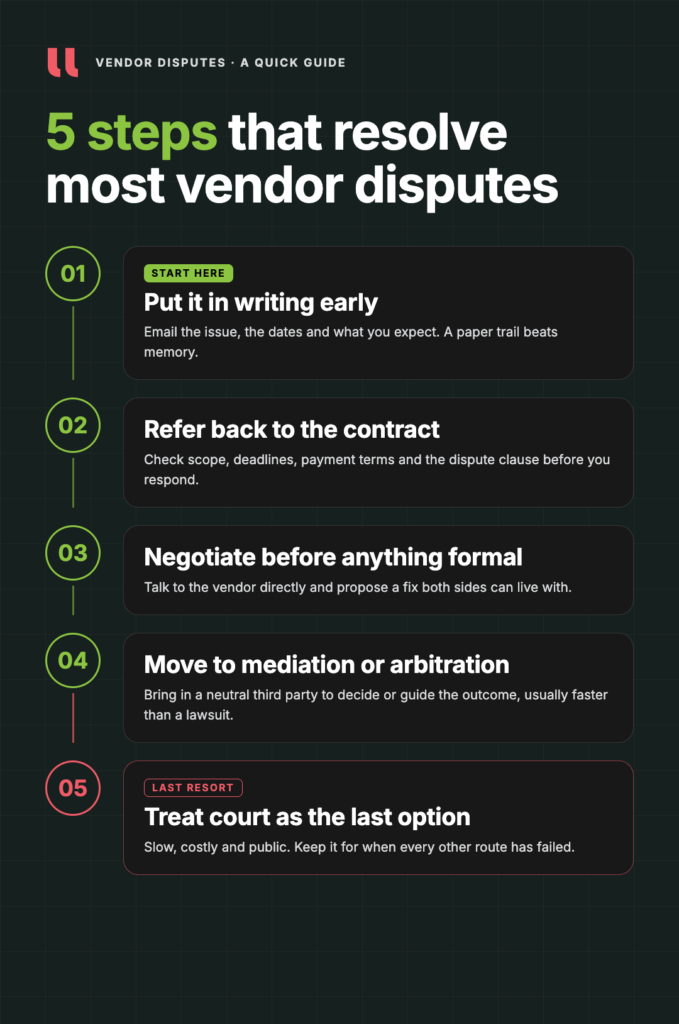
1. Put it in writing early
Raise the issue directly, and do it by email or WhatsApp rather than a phone call. Most vendors want to fix a problem before it escalates. The written trail costs nothing now and becomes the case later.
2. Refer back to the contract
Check what was actually agreed, not what was assumed. Contract terms on timelines, quality, and penalties shape how the dispute should be handled.
A clear arbitration clause in the vendor agreement can also determine how the matter will be resolved if negotiations fail.
3. Negotiate before anything formal
Faster, cheaper, and far more likely to leave the commercial relationship intact. Put any agreed variation, such as a revised schedule, a partial credit note, a discount for the rejected lot, in writing the same day.
4. Move to mediation or arbitration
Mediation helps both sides reach a settlement they choose; arbitration puts the decision to a neutral and ends in a binding award enforceable as a court decree.
Understanding the main types of alternative dispute resolution helps you pick the right one rather than defaulting to whichever your lawyer prefers.
If negotiation stalls, CADRE ODR can help vendors and buyers move from an unresolved demand to structured mediation or arbitration with an experienced neutral.
5. Treat court as the last option
Litigation means advocate fees across repeated hearings, your team’s time, and a judgment that can still be appealed. Arbitration ends on a fixed timeline.
Preventing future vendor payment disputes
Most payment disputes are preventable with a few habits in place:
- Set clear payment terms: Define due dates, milestones, and penalties upfront, in writing.
- Confirm invoices before payment: Match every invoice against the agreed contract and delivery before releasing funds.
- Keep financial records in order: Clean records make it easy to resolve a disagreement quickly, with evidence on hand.
- Check in with vendors regularly: Short, periodic conversations catch small issues before they become disputes.
Businesses that build these habits tend to see fewer disputes and resolve the ones that do arise faster.
How Indian law treats vendor dispute resolution
Indian law increasingly favours resolving commercial disputes before they reach a courtroom. This legal direction is visible across legislation, court decisions, and regulatory frameworks:
- Mandatory pre-institution mediation: Section 12A of the Commercial Courts Act requires parties to attempt mediation before filing most commercial suits where no urgent interim relief is sought. This can apply to vendor, payment, and contract disputes.
- Recognition of electronic notices: In Lease Plan India v. Rudraksh Pharma, the Delhi High Court upheld the enforceability of electronic notices sent through WhatsApp and email.
- If you’re the one who hasn’t been paid, and you are a registered micro or small enterprise, Sections 15 and 16 of the MSMED Act, 2006 require the buyer to pay within the agreed date and in any case within 45 days of acceptance, failing which compound interest runs monthly at three times the RBI bank rate.
- Regulatory adoption: As of July 2026, SEBI’s SMART ODR portal reflects growing regulatory confidence in online resolution for securities and related commercial disputes.
CADRE aligns with this broader legal shift through documented notices, structured online proceedings, dedicated case support, and binding arbitral awards.
Where CADRE fits in the vendor dispute resolution process
A vendor relationship rarely breaks over one missed delivery or one late invoice. It breaks over how long the disagreement is left to sit.
CADRE (India’s simplest online dispute resolution platform) runs mediation, conciliation and arbitration online, with a case officer on every matter, documented multi-channel notices, and an auditable record of every submission. It has resolved 35,000+ matters carrying ₹1,000+ crore in claim value, typically in under 45 days.
If a vendor dispute is holding up your business, CADRE offers a typically faster route to resolution.
FAQs on vendor service failure
Start by identifying the root cause, then raise it directly with the vendor. Refer to the contract, negotiate where possible, and turn to mediation or arbitration if talks stall.
Set clear payment terms upfront, confirm invoices before paying, and keep clean financial records. Regular check-ins with vendors catch payment issues early, before they escalate.
It’s a disagreement arising when a vendor fails to meet contractual obligations, whether through late delivery, poor-quality goods, delayed payments, or other contractual terms not being honoured.
Missing an agreed delivery date, supplying goods that do not meet specifications, or failing to honour warranty or service terms are common examples of vendor service failure.
Yes. Most vendor disputes settle through negotiation, mediation, or arbitration, offering a faster, binding outcome without the delay of formal litigation.