

TL;DR
Arbitration in banking and finance gives lenders a final award enforceable under Section 36, but only if the clause names an independent appointment process, a defined seat, and preserves Section 9 court relief.
CADRE, India’s simplest online dispute resolution platform, helps lenders resolve debt claims efficiently while preserving statutory recovery rights.
In a crowded civil court, a credit card default or working capital claim sits among thousands of unrelated cases.
A poorly written arbitration clause turns a straightforward debt claim into a multi-year jurisdictional fight and ramps up the costs.
For Indian banks and non-banking financial companies (NBFCs), delayed recovery locks up capital and drives up Non-Performing Asset (NPA) provisioning.
While courts remain vital public institutions, routine commercial recovery demands a faster, dedicated mechanism.
Read further to learn how to draft clear arbitration clauses, navigate Indian legal realities, and use online dispute resolution providers to protect capital and speed up recovery.
What is arbitration in finance?
Arbitration in finance is a private, statutorily recognised dispute resolution mechanism under the Arbitration and Conciliation Act, 1996, where an independent neutral renders a final award under a contractual agreement.
Financial agreements span corporate facilities, structured market instruments, and retail credit. Understanding how arbitration proceedings operate in India helps legal teams evaluate where private resolution fits across different banking portfolios:
- Loan defaults: Working capital lines, term loans, equipment finance, and asset-backed facilities.
- Trade finance: Letters of credit, bank guarantees, discounting facilities, and supply chain funding.
- Market agreements: Interest-rate swaps, forward contracts, derivatives, and treasury arrangements.
- Retail credit: Credit cards, personal loans, micro-finance, and buy-now-pay-later (BNPL) claims.
For example, if a company defaults, an arbitration clause might let you secure a binding award in months, avoiding years of litigation delays.
4 reasons why financial institutions are shifting from courts to arbitration
Financial institutions adopt arbitration to avoid provisioning drag, protect financial records under statutory confidentiality rules, appoint specialised neutrals, and enforce across over 170 countries.
Lenders manage high-volume portfolios across retail and commercial debt. They adopt arbitration for clear operational reasons:
1. Avoid prolonged recovery and speed up final decisions
Prolonged court litigation keeps stressed assets frozen on balance sheets, forcing lenders to set aside regulatory capital under Reserve Bank of India (RBI) guidelines for loan recovery.
Fast-track private proceedings reduce recovery timelines and yield awards that are final under Section 35 of the Arbitration and Conciliation Act, 1996.
One change from the 2015 amendment matters more than any other for a lender. Under Section 36(2), filing a Section 34 challenge does not by itself stop enforcement.
The award-debtor must apply separately under Section 36(3) and persuade the court to grant a stay, which it may do on conditions such as security or deposit. In practice, this is the single biggest difference between an award and a decree under appeal.
2. Have more privacy and market trust
Public court filings can expose proprietary underwriting models, sensitive customer exposure, and confidential debt restructuring discussions.
Section 42A of the Act requires the arbitrator, arbitral institution, and parties to maintain strict confidentiality throughout proceedings.
However, this privacy is not absolute; if an award is subsequently challenged under Section 34 or enforced under Section 36, court filings become part of the public record.
Lenders can also evaluate the true financial cost of court recovery versus ODR when planning portfolio-wide recovery strategies.
3. Ability to appoint neutral expert arbitrators
Civil court judges manage varied dockets ranging from criminal matters to property disputes. Arbitration allows financial institutions to select neutral decision-makers with specific domain expertise in syndicated lending, credit derivatives, and structured finance instruments.
4. Easy global enforcement
Cross-border corporate lending and trade finance continue to expand across emerging markets.
While domestic court judgments face complex reciprocal enforcement hurdles abroad, arbitral awards benefit from international recognition across over 170 jurisdictions under the 1958 New York Convention.
Selecting neutrals with banking experience avoids wasting time explaining standard credit documentation during hearings.
Why the right arbitration clause matters in financial contracts
A clear arbitration clause establishes clear tribunal jurisdiction, while ambiguous drafting triggers preliminary court battles under Section 8 or Section 11.
When a default occurs, vague contract language leads to preliminary fights over forum selection rather than prompt debt resolution. Legal teams drafting financial documentation must focus on 4 structural elements:
- Seat vs. venue: The legal seat determines which court holds supervisory jurisdiction over interim relief and award challenges. The venue is merely the meeting location. Casually naming the venue without specifying the seat invites jurisdictional litigation.
- Institutional over ad-hoc: Institutional arbitration offers established procedural rules, predictable fee schedules, independent appointments, and administrative support. Ad hoc arbitration relies on manual party coordination.
- Governing law and language: Explicitly stating Indian substantive law and English (or both your preferred tongue) as the language of arbitration eliminates translation costs and conflict-of-law disputes.
- Arbitrator expertise: Requiring arbitrators to possess background experience in banking, commercial law, or financial markets prevents procedural delays during hearings.
For complex syndicated credit facilities, clauses must include explicit provisions for joinder and consolidation.
This permits a single tribunal to resolve connected claims across primary borrowers, corporate guarantors, and pledged security providers in one consolidated proceeding.
For instance, consider three banks lending to an infrastructure project. Matched arbitration clauses let all three lenders resolve default claims against the borrower in one shared proceeding. If the clauses differ, recovery splits into three separate legal fights.
Checklist for drafting a banking arbitration clause that holds
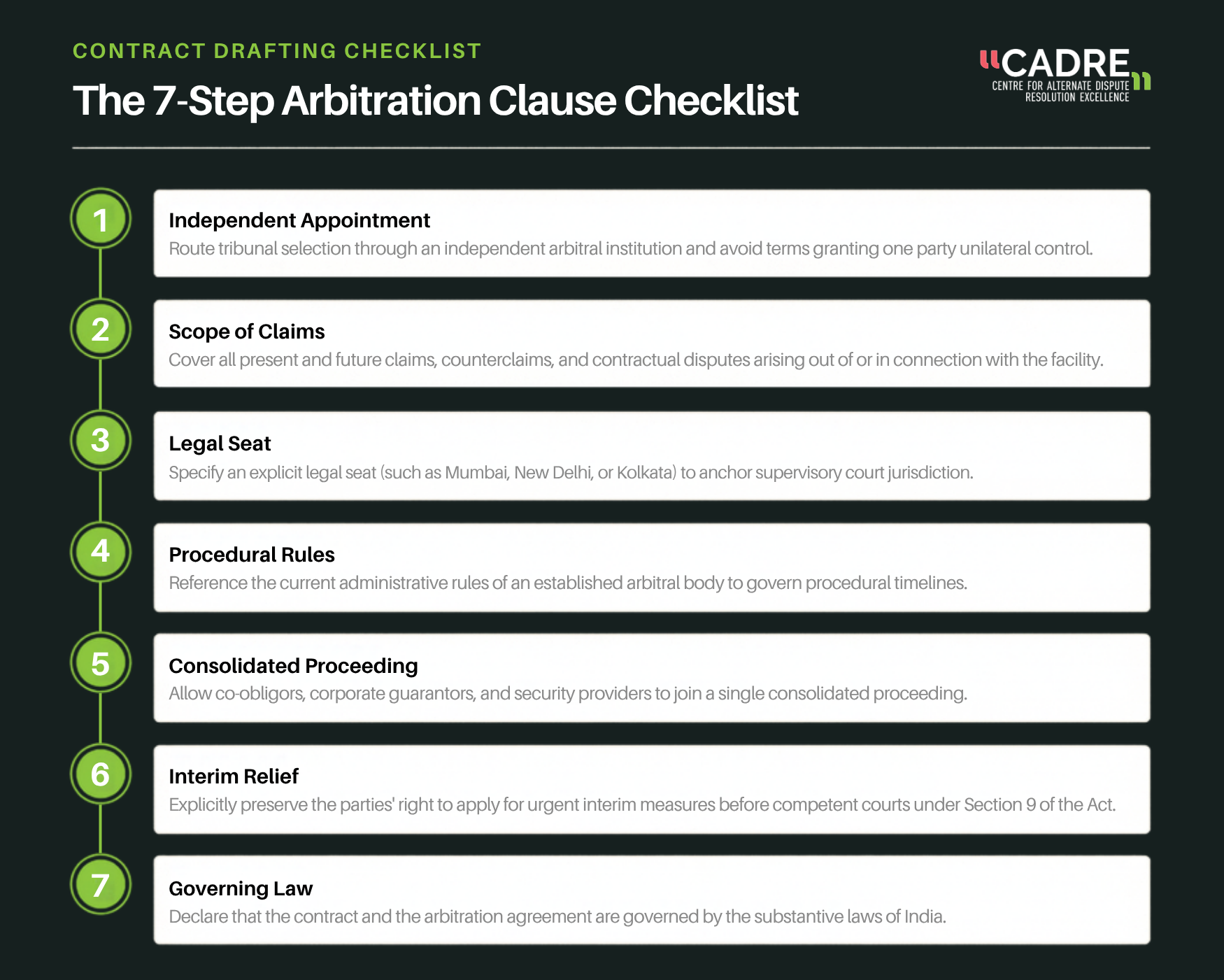
A financial arbitration clause must designate an independent appointing authority, explicitly fix the legal seat, incorporate institutional rules, and preserve statutory interim remedies under Section 9.
Review contract templates against this 7-step checklist before closing financing documentation; legal teams can adapt simple arbitration clause templates to ensure independent appointment and clear seat designation are built in from day one:
3 common pitfalls to avoid in financial arbitration clauses
Lenders must avoid mixing court jurisdiction schedules with arbitration clauses, imposing asymmetrical option terms, or creating conflicting dispute terms across linked security documents.
Minor drafting errors in high-volume credit documentation generate procedural friction and defer recovery.
1. Mixed template language
Legacy contract templates often mix general court jurisdiction clauses with arbitration schedules. This occurs when business teams reuse old precedents or integrate acquired loan portfolios without revising dispute terms.
When a default happens, courts must hold preliminary hearings just to clarify party intent, delaying recovery for lenders managing high-volume portfolios.
2. Unilateral and asymmetrical clauses
Asymmetrical clauses attempt to give one party (typically the lender) the option to choose between litigation and arbitration while restricting the borrower to arbitration alone.
Furthermore, granting a lender unilateral power to appoint a sole arbitrator violates core procedural equality.
Following the Supreme Court Constitution Bench decision CORE II, 2024, clauses that fail to guarantee independent, balanced tribunal selection face strict judicial challenge.
3. Isolated multi-contract deals
Large commercial financing transactions involve multiple linked contracts, including facility agreements, personal guarantees, and mortgage deeds.
If the primary loan agreement mandates arbitration while the guarantee deed points to civil court jurisdiction, a default forces the lender to split its recovery strategy into parallel proceedings.
Legal realities of arbitration in banking disputes in India
Arbitration in Indian banking operates alongside statutory recovery frameworks. It’s only valid if claims fall within arbitrable contractual parameters and comply with independent tribunal appointment rules.
Indian banking disputes draw on the Arbitration and Conciliation Act, 1996, alongside statutory laws like the Recovery of Debts and Bankruptcy Act, 1993 and the SARFAESI Act, 2002.
How those three regimes interact determines how much of any given dispute can actually be referred to arbitration.
What claims can go to arbitration?
In the Vidya Drolia case, the Supreme Court explained that some disputes cannot be arbitrated because they affect rights against the public.
That principle has a direct consequence here.
If a bank or specified financial institution is trying to recover more than ₹20 lakh, the case must be handled by a Debt Recovery Tribunal (DRT) under the 1993 Act. The parties cannot avoid the DRT by agreeing to resolve the dispute through private arbitration.
Legal teams should evaluate when arbitration is necessary vs litigation to assign default claims to the appropriate forum. Lenders can also examine strategies for moving small-ticket NBFC loan recovery into ODR frameworks to handle high-volume unsecured books efficiently.
Running SARFAESI and arbitration together
In M.D. Frozen Foods Exports Pvt. Ltd. v. Hero Fincorp Ltd. (2017), the Supreme Court confirmed that SARFAESI and arbitration can work together.
Two limits govern who can do this. SARFAESI is available only to secured creditors, and only to institutions the Central Government has notified under the Act – for NBFCs, that currently means those above a specified asset size, and only for secured debt above a specified floor.
Hero Fincorp was a notified NBFC, which is why the mechanism was available to it. An NBFC below the threshold, or one lending unsecured, has no SARFAESI route at any ticket size.
Where it does apply, SARFAESI lets the lender seize and sell pledged collateral without court action.
If the asset sale does not cover the full debt, arbitration helps the lender secure a binding money award for the remaining balance.
Unilateral arbitrator appointments and the CORE II ruling
On November 8, 2024, a 5-Judge Constitution Bench ruled in CORE II that an interested party cannot appoint the sole arbitrator on its own and set fairness requirements.
Because of these judicial developments, independent institutional appointment mechanisms are vital.
Institutions such as CADRE follow structured appointment processes to ensure neutral panels and protect awards from procedural challenges.
The role of online dispute resolution in modern banking
Online dispute resolution handles high-volume retail defaults by moving the process online, cutting resolution timelines from years to weeks.
For instance, taking a ₹25,000 credit card default to court might cost more than the debt itself.
ODR uses digital portals and secure automation to resolve claims without physical meetings.
How ODR works in practice
Modern ODR platforms streamline financial recovery while maintaining statutory due process:
- Digital setup: The lender securely uploads default case records to the platform portal.
- Digital notices: The borrower gets clear notices by email or messaging apps with a direct portal link.
- Online conciliation: Both sides use a secure online portal to discuss payment plans or settlement terms.
- Online arbitration: If talks fail, an independent neutral reviews the digital documents and issues an e-signed award.
For Indifi, the bottleneck was reaching borrowers at all. Tracked physical mail alone was unreliable, and letters went unread, and addresses had changed.
Pairing it with multichannel digital notices meant respondents were served and engaged early rather than late, and the first hearing was held on Day 20. The matter closed with a binding award in 62 days.
Regulatory backing in India
Indian regulatory policy consistently supports technology-enabled dispute resolution. Under its master circular framework, SEBI established the SmartODR portal for capital market disputes, enabling the routing of unresolved investor complaints to accredited ODR institutions, including CADRE.
CADRE, India’s simplest online dispute resolution platform, helps financial institutions process default claims securely while maintaining full legal compliance.
Build a stronger dispute-resolution process
A clear arbitration clause protects cash flow and speeds up debt recovery. While courts handle mortgage foreclosures, private arbitration and ODR offer speed and privacy for routine debt.
CADRE, India’s simplest online dispute resolution platform, helps financial institutions resolve loan defaults through qualified neutrals and secure digital processes.
FAQs for arbitration in banking and finance
Under Section 29B, the parties may agree to use a fast-track process. The case is usually decided mainly through documents and written submissions, and the award should be issued within six months after the tribunal begins the reference.
Arbitration requires voluntary contractual consent, involves upfront institutional fees, cannot issue binding orders against non-signatory third parties without specific legal grounds, and provides limited public precedent for broader market guidance.
Not always. Court filing fees are lower, but years of delays raise total expenses. While arbitration requires paying arbitrator fees, its fast timeline and limited appeals often make it more cost-effective overall for commercial disputes.