
TL;DR
When commercial disagreements arise, choosing between consensual settlement and binding adjudication determines your resolution timeline.
While mediation offers flexible, party-agreed outcomes, arbitration yields an arbitral award enforceable in court under Section 36.
CADRE, India’s simplest online dispute resolution platform, administers both pathways through transparent digital workflows grounded in Indian law.
When an unpaid invoice or contract breach stalls daily business, you need a process that clears the conflict without years of delay.
Court litigation remains essential for resolving major public legal issues in India, but commercial disputes often require faster, private solutions that protect cash flow and business ties.
Alternative dispute resolution (ADR) allows parties to settle commercial conflicts through mediation and arbitration outside public courtrooms. While both options avoid long trial delays, they operate under different legal frameworks.
Selecting the right path requires understanding how each method functions under Indian law and how online dispute resolution (ODR) streamlines the resolution process.
Understanding mediation and arbitration
Mediation is a consensual, facilitated negotiation process where parties attempt to reach a voluntary settlement.
Whereas arbitration is a binding adjudicatory process where an independent tribunal evaluates evidence and issues an arbitral award.
Both mechanisms operate privately outside open courtrooms, while remaining subject to statutory supervision by Indian courts at defined stages under the Arbitration and Conciliation Act, 1996.
What is mediation and how does it work?
Mediation is a consensual process. A neutral third party, called the mediator, facilitates conversation between both sides.
The mediator does not judge fault, evaluate witness demeanour, or impose an outcome.
Instead, the mediator structures discussions, clarifies underlying commercial interests, and assists the parties in drafting a mutually acceptable resolution.
A signed mediated settlement is binding on the parties as a contract, independent of the Mediation Act’s own decree-enforcement route.
Since Section 27 decree enforcement remains uncommenced, parties needing immediate decree-level power can use Part III conciliation instead.
A settlement signed under Section 73 acquires the status of an arbitral award on agreed terms under Section 74, enforceable as a decree under Section 36.
For instance, an engineering firm and a component supplier facing a contract dispute over delayed deliveries can use mediation to adjust delivery schedules and restructure payment terms, resolving the disagreement while preserving an ongoing supply relationship.
What is arbitration and how does it work?
Arbitration is a formal, rights-based adjudicatory process where parties submit their dispute to an independent neutral arbitrator or tribunal.
The arbitrator reviews written pleadings, evaluates documentary evidence, hears legal submissions, and renders a reasoned decision called an arbitral award.
Unlike a mediator, an arbitrator exercises statutory authority to decide the matter conclusively, regardless of whether both parties agree with the final outcome.
Under Section 35 of the Arbitration and Conciliation Act, 1996, an arbitral award is final and binding on the parties.
Once the statutory challenge period passes under Section 34, civil courts enforce the arbitration award in proper format under Section 36 in the same manner as a court decree, if required.
Notably, the mere filing of a Section 34 application does not automatically stay enforcement.
Key differences between mediation and arbitration
The main difference between mediation and arbitration comes down to who makes the final decision, how formal the steps are, and how strictly legal rules apply.
The practical split between these two methods becomes clear when comparing key features side by side.
| Comparison metric | Mediation | Arbitration | Court litigation |
| Main goal | Mutual agreement | Final private decision | Public legal judgment |
| Role of neutral | Guides conversation | Acts as neutral adjudicator | State court judge |
| Control over result | Full party control | Arbitrator decides | Judge decides |
| Legal outcome | Voluntary settlement | Enforceable award | Enforceable court decree |
| Process style | Simple and flexible | Structured legal rules | Rigid court codes |
| Privacy | Completely private | Private hearings | Public record |
| Best used for | Saving business ties | Final legal resolution | Non-arbitrable matters, third-party rights, enforcement |
While mediation lets you keep total control over settlement terms, arbitration gives you a firm decision when talks stall.
CADRE handles both options online, using qualified neutrals who ensure every step complies with Indian law.
Core differences explained
Let’s understand 4 core differences in more depth so you understand the distinction better:
- Role of the neutral:
A mediator manages dialogue to help parties construct their own agreement.
An arbitrator receives evidence, applies substantive law, and issues an award that determines legal rights and liabilities.
- Legal enforceability:
A conciliated settlement signed under Section 73 acquires, by Section 74, the same status and effect as an arbitral award on agreed terms under Section 30, and is therefore enforceable as a decree under Section 36.
An arbitral award is enforceable as a civil court decree after the Section 34 challenge period expires.
- Procedural constraints:
Mediation is not bound by formal procedural codes or evidentiary standards.
Arbitration is governed by statutory deadlines, including 6 months for completion of pleadings under Section 23(4) and 12 months for rendering an award under Section 29A(1) for domestic arbitrations.
- Allocation of risk:
In mediation, neither party risks an adverse legal finding because no settlement can be finalized without mutual consent.
In arbitration, the tribunal renders a binding decision based on contractual terms and documentary proof, creating a clear winning and losing position on each claim.
Difference between arbitration, conciliation, and mediation in India
Mediation relies on party dialogue, arbitration yields a binding award, and Part III conciliation lets a neutral propose terms enforceable like a court decree under Section 74.
Understanding these paths helps businesses select the right fit.
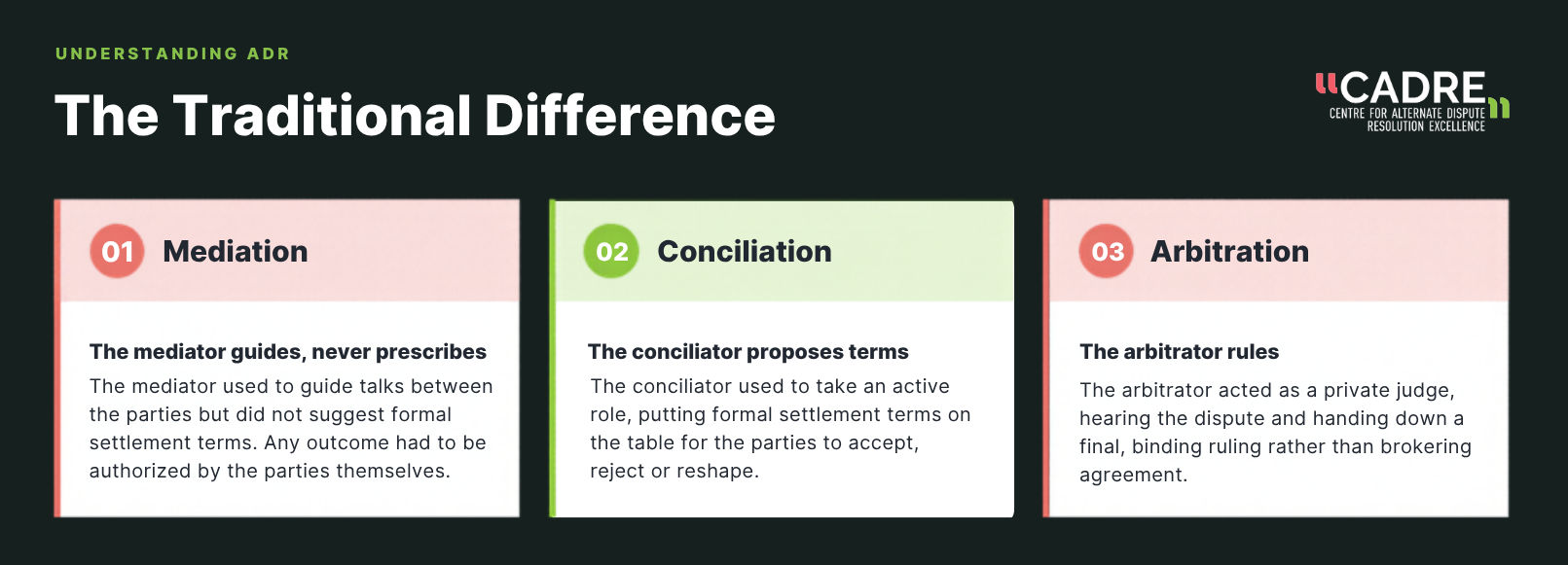
The traditional difference
Historically, Indian dispute resolution frameworks drew a distinction between mediation and conciliation:
The operational reality of Part III conciliation
Because the repeal of Part III of the 1996 Act remains uncommenced as at August 2026, conciliation remains an active statutory framework.
Under Section 67, a conciliator proposes settlement terms.
Signed settlements under Section 73 carry the status of an arbitral award on agreed terms (Section 30/74), making them directly enforceable as civil court decrees under Section 36.
Mandatory pre-institution mediation under Section 12A
Under Section 12A of the Commercial Courts Act, 2015, commercial suits valued at ₹3 lakh or more without urgent interim relief require pre-institution mediation before filing.
Per Afcons Infrastructure (2010), courts can direct parties into mediation, Lok Adalat or judicial settlement without their consent, but cannot refer a dispute to arbitration or conciliation unless all parties agree.
How mediation and arbitration can be combined
Under Section 30 of the 1996 Act, arbitral tribunals can encourage mediation or conciliation during proceedings.
If parties settle, the tribunal records it as an arbitral award on agreed terms, granting immediate finality under Section 35 and decree-level enforcement under Section 36.
How online dispute resolution in India works
Online dispute resolution in India brings mediation and arbitration onto secure digital platforms, replacing physical courtrooms with virtual hearings and online document filing.
Digital tools make resolving disputes simpler and faster across India. By moving cases online, businesses avoid travel costs, schedule meetings quickly, and solve claims in weeks.
Legal validity of online mediation and arbitration
The legality of administering mediation, conciliation, and arbitration online rests on established Indian statutes and judicial precedents:
- Section 7(4)(b), Arbitration and Conciliation Act, 1996: Expressly validates arbitration agreements contained in electronic communications, including emails, digital messages, and platform records.
- Section 19, Arbitration and Conciliation Act, 1996: Confirms that the arbitral tribunal is not bound by the Code of Civil Procedure, 1908 or strict evidence rules, empowering the tribunal and parties to determine digital procedures and online document submissions.
- Section 24(1), Arbitration and Conciliation Act, 1996: Authorizes the tribunal to decide whether to hold oral hearings or conduct proceedings on the basis of documents and electronic records, subject to holding an oral hearing upon a party’s request.
- Sections 4, 5, and 10A, Information Technology Act, 2000: Provide full legal recognition to electronic records, digital signatures, and contracts formed through electronic means.
- Sections 61 and 63, Bharatiya Sakshya Adhiniyam, 2023 (BSA): Recognise electronic records and digital audit trails as primary and admissible evidence in Indian courts.
- Judicial Recognition: In a milestone 2025 decision, the Bombay High Court upheld the legal validity of an online platform-administered appointment where the ODR institution was pre-agreed in the contract.
Settlements signed online and digitally issued arbitral awards carry the same legal force as their paper equivalents, subject to the same limited challenge grounds.
Here is how it typically goes at CADRE step-by-step:
- Digital notice and case setup: Dispute details and notices are issued through secure digital portals.
- Neutral appointment: Independent, qualified mediators or arbitrators are assigned to the matter.
- Virtual meetings: Parties participate in encrypted video hearings (or other types of communications) and upload documentation online.
- Enforceable digital result: Parties receive an e-signed mediated settlement or digital arbitral award.

Where digital resolution works best
Online resolution works best for recurring, commercial disputes, such as:
- Unpaid loan recoveries for banks and finance companies
- Delayed payment claims between suppliers and buyers
- Rent and lease adjustments for commercial property and co-working spaces
- Full-and-final settlement disputes between employers and workers
CADRE was among the ODR providers SEBI consulted when designing its framework for securities-market disputes, and is one of the institutions empanelled on the SMART ODR portal.
For instance:
CADRE managed end-to-end arbitration between Practo and hospitals across Delhi and Mumbai over unpaid referral commissions.
Key results included:
Amicable settlements: Resolved multiple matters through mutual agreement during proceedings.
Reasoned awards despite non-participation: Where respondents chose not to participate after being served, the tribunal proceeded under Section 25(b) of the Arbitration and Conciliation Act, which requires it to continue on the merits rather than treat silence as an admission, and issued reasoned awards.
Process efficiency: Delivered fast, fair, and legally compliant outcomes across high-volume disputes.
How to choose the right pathway for your dispute
Pick mediation when you want to protect a business relationship and control the agreement, or pick arbitration when talks have completely broken down, and you need an enforceable final ruling.
Let’s get into it a bit more.
When to choose mediation
Mediation is the better path when:
- You want to keep working together: You need to maintain a business relationship with a vendor, partner, or client after solving the issue.
- You need creative settlement terms: The best solution involves non-monetary fixes, such as changing delivery dates, restructuring payment schedules, or updating contract terms.
- You want full control: You do not want to risk an unexpected ruling from an outside decision-maker.
When to choose arbitration
Arbitration is the better path when:
- Talks have completely broken down: Communication has failed, and the other party refuses to negotiate fairly.
- You need an absolute, binding decision: You require a final ruling that can be enforced against assets without lengthy appeals.
- Your contract requires it: The underlying agreement includes a mandatory arbitration clause under the Arbitration and Conciliation Act.
You do not have to pick only one option. A well-written contract can use a multi-step clause, requiring structured mediation first and automatically moving to binding arbitration only if talks do not resolve the matter within a set timeline.
Resolving commercial disputes faster
Relying on traditional litigation for routine commercial disagreements exposes balance sheets to provisioning drag, management distraction, and customer attrition.
Mediation and conciliation offer speed, privacy, and control to preserve vital commercial ties, while arbitration delivers a definitive, binding award enforceable in the same manner as a court decree under Section 36.
To settle a dispute efficiently, CADRE, India’s simplest online dispute resolution platform, offers secure digital workflows, qualified neutrals, and complete enforceability under Indian law.
FAQs for arbitration and mediation
There is no set winner. An arbitrator acts like an independent judge and decides based on contract terms, written evidence, and Indian law. The party with clear documentation, valid financial records, and strong legal evidence usually succeeds.
Yes. A mediated settlement is legally binding as a contract. For immediate decree-level enforcement, executing it via Part III conciliation under the Arbitration and Conciliation Act, 1996 grants it arbitral award status (Section 74), enforceable under Section 36.
Mediation is usually cheaper, and the reason is structural rather than a matter of rates. It runs on fewer sessions, needs no evidence phase, and involves one neutral rather than a panel. Arbitration carries the tribunal’s fees, formal evidence submission and a longer timeline, but it produces an enforceable award, which a failed mediation does not.
Usually, yes. Section 12A of the Commercial Courts Act, 2015 requires pre-institution mediation for commercial suits of ₹3 lakh or more that do not contemplate urgent interim relief. A settlement reached there has the status of an arbitral award on agreed terms under Section 30(4) of the 1996 Act, so it is enforceable as a decree.
Both parties usually split the mediator fees and platform costs equally. However, parties can agree on a different arrangement in their underlying contract or as part of their final settlement terms on CADRE.