
TL;DR
A cheque bounce case is a criminal matter under Section 138 of the Negotiable Instruments Act, with strict notice and filing deadlines. But the offence is compoundable so that parties can settle at any stage.
CADRE, India’s simplest online dispute resolution platform, helps you reach a documented, enforceable settlement without the long wait.
A bounced cheque starts a clock, and the clock does more to decide the outcome than the merits do.
You have 3 months to present the cheque, 30 days from the bank’s return to send a demand notice, 15 days to let the drawer pay, and 1 month after that to file. Every one of those steps has to happen in order, and a complaint that skips one is liable to be thrown out before anyone looks at whether you were owed the money.
What follows is the sequence, the court to file in, what the case actually costs, what counts as a defence – and the part most articles get wrong: how a cheque bounce case is legally settled, and what a settlement is and isn’t worth.
This is general information about the law and cheque bounce cases. Do not consider it as legal advice on your dispute.
What is a cheque bounce case?
A cheque bounces when a bank returns it unpaid, usually because the account has insufficient funds. If it was issued to discharge a genuine debt, the payee can seek a remedy under Section 138 of the Negotiable Instruments Act, 1881 tried by a magistrate as a summary trial.
Four things about the offence shape everything that follows:
- Punishment: up to two years’ imprisonment, a fine of up to twice the cheque amount, or both.
- Nature: bailable, non-cognizable, and compoundable – meaning the parties can lawfully close it by agreement.
- Presumption: once the drawer admits the signature, Section 139 presumes the cheque was issued against a legally enforceable debt. The burden shifts to the drawer to displace it, on a balance of probabilities.
- Trial: normally tried summarily by a magistrate under Section 143, though the magistrate may switch to summons-trial procedure where a sentence of more than one year may be warranted.
Section 143A also lets the court direct the drawer to pay interim compensation of up to 20% of the cheque amount while the trial runs.
It is worth knowing that this is not automatic: in Rakesh Ranjan Shrivastava v. State of Jharkhand (2024 INSC 205), the Supreme Court held the power under Section 143A(1) is discretionary, not mandatory – the court must weigh the strength of the complaint and the plausibility of the defence before ordering it.
The cheque bounce case procedure: 4 deadlines to keep in mind
Each stage must be completed before the next begins.
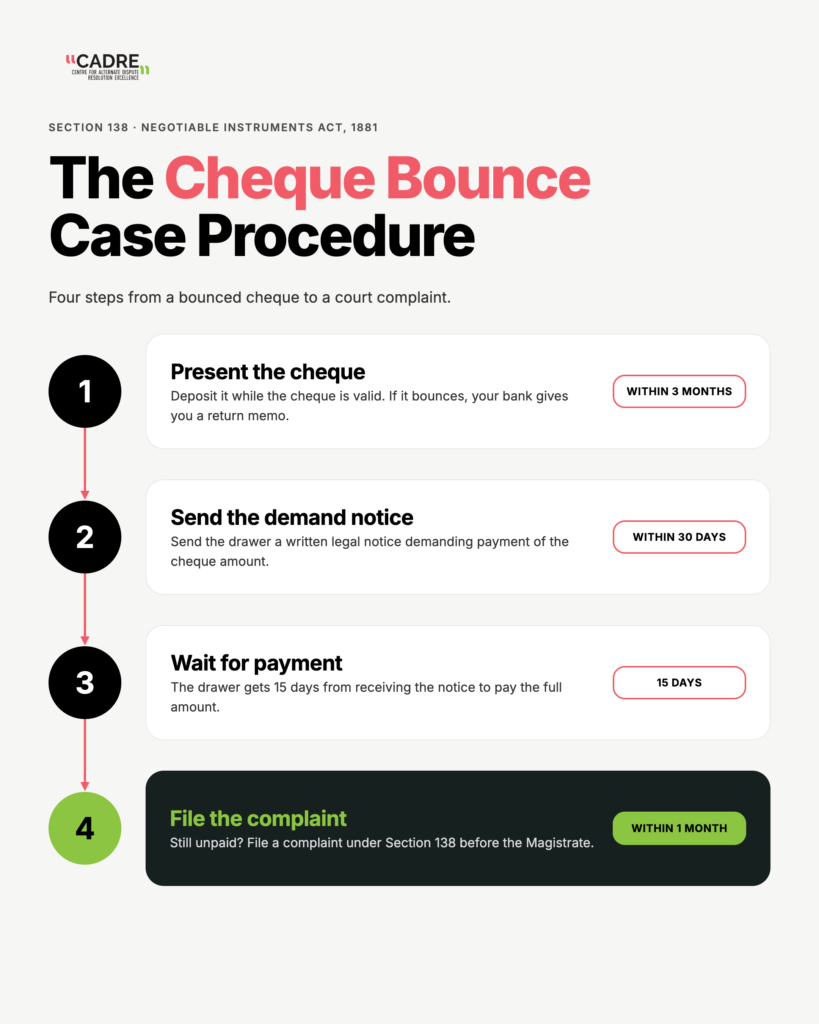
| # | Step | Deadline | If you miss it |
| 1 | Present the cheque | Within 3 months of the date on the cheque | The instrument is stale. The bank won’t pay it and no cause of action arises. |
| 2 | Send the demand notice | Within 30 days of receiving the bank’s information that the cheque was returned | No offence is made out on that dishonour. |
| 3 | Wait for payment | 15 days from the drawer’s receipt of the notice | Filing before day 16 is premature – the cause of action has not yet arisen. |
| 4 | File the complaint | Within 1 month of that 15-day period expiring | The complaint is out of time, though the court may still take cognizance if you satisfy it there was sufficient cause for the delay. |
Anyone regularly recovering money owed to them in India should treat notice drafting and proof of service as the operational priority.
Where to file your complaint
Filing in the wrong court gets a complaint sent back before it’s even heard. Jurisdiction trips up more complainants than any other step.
Section 142(2)(a) of the NI Act fixes jurisdiction at the court within whose local limits the branch where the payee maintains the account into which the cheque was delivered for collection is situated. Where a cheque is presented over the counter rather than through an account, Section 142(2)(b) points instead to the branch of the drawee bank.
For a business, that is genuinely useful as it means you can generally file where you bank, not where your customer does.
What a cheque bounce case actually costs
The filing fee itself is rarely what makes a cheque bounce case expensive. It’s small, state-specific, and set under the Court Fees Act, 1870.
The real cost sits in what follows it:
- Advocate fees across every hearing, not a one-time payment
- Repeated court appearances, often over several months
- Management or business time lost to attending or preparing for each hearing
- Travel to and from court, every time the matter is listed
- Process, service, and enforcement costs once a judgment is finally passed
None of this is fixed upfront, and it compounds the longer the case drags on.
The difference becomes clearer when you examine what it really costs to recover a ₹2 lakh default through court compared with ODR.
This is exactly the cost ODR is built to cut: a platform like CADRE resolves matters in days. It is fully virtual, so you avoid repeated hearings, travel, and an advocate meter running for months.
Contesting a cheque bounce case
A bounced cheque does not automatically result in conviction. Once the drawer admits signing the cheque, the court generally presumes that it was issued to repay a legally enforceable debt.
The drawer must then raise a credible defence supported by the facts or evidence. A simple denial is usually not enough. Common defences may include:
- No legally enforceable debt: The cheque was not issued for an amount the drawer was legally required to pay.
- No payment due when presented: This may apply to a security cheque if the liability had not arisen when it was deposited.
- Invalid demand notice: The notice was late or did not clearly demand the cheque amount.
- Required procedure not followed: The payee missed a deadline for presenting the cheque, sending the notice or filing the complaint.
If none of these is available and the drawer simply owes the money but needs time to pay, a defence is usually the more expensive path. That is where the compounding provisions come in, and where the law is unusually explicit about rewarding speed.
Resolving cheque bounce cases with ODR
Online dispute resolution is simply this set of processes – negotiation, mediation, conciliation, arbitration – run on a digital platform instead of in a room. If you want the underlying concepts first, start with how arbitration works in India.
For a cheque bounce dispute, the practical advantages of ODR are:
- Speed against the compounding clock: Every week of delay moves the matter towards the 10% band and then the 15% band. A process measured in weeks rather than years is worth real money to the drawer, which is what makes them engage.
- Notice and engagement: Multi-channel notices in ten languages, with delivery tracking, reach drawers who ignore a formal notice from an unfamiliar law firm.
- A record that survives scrutiny: Every notice, submission and settlement term sits in one auditable log, which is what a magistrate needs to see when the compounding application is moved.
- Asynchronous participation: No hearing dates, no travel, no adjournments because one side’s counsel is in another court.
CADRE, India’s simplest online dispute resolution platform, runs these processes end-to-end on its own technology. Across banking, NBFC, MSME and commercial disputes, it has resolved 35,000+ matters carrying ₹1,000+ crore in claim value, with 300+ panelled dispute-resolution professionals and 35+ institutional clients.
Matters are typically resolved in under 45 days, and the platform is ISO 27001:2022 certified and DPIIT recognised.
| Court route | ODR with CADRE | |
| Timeline | Several months to years | Typically under 45 days |
| Format | In-person hearings | Paperless and virtual |
| Appearances | Repeated court visits | Minimal to none |
| Cost | Accrues per hearing | Known at the outset |
| Outcome | Judgment, then enforcement | Documented settlement terms, then compounding on consent |
If a bounced cheque is holding up money you are owed, the cheapest week to settle it is this one. CADRE offers a structured, fully online route to a documented settlement – and if you would rather talk it through first, start a conversation with the CADRE team.
FAQs on cheque bounce cases
It is a criminal offence under Section 138 of the Negotiable Instruments Act, punishable with up to two years’ imprisonment, a fine up to twice the cheque amount, or both.
Courts can now order the drawer to pay interim compensation of up to 20% of the cheque amount during the trial, alongside a continued push for faster disposal.
No, it is not an FIR-based offence, so the payee must file a complaint before a magistrate rather than approach the police.
Get the bank return memo, send a demand notice within 30 days, and either settle the amount or file a complaint if it stays unpaid after 15 days.
Yes, the offence is compoundable under Section 147, so both parties can settle at any stage, and online dispute resolution makes that settlement faster and documented.