TL;DR
Alternative dispute resolution (ADR) includes arbitration, mediation, conciliation, Lok Adalat, and online dispute resolution (ODR). ADR settles civil and commercial disputes faster, cheaper, and in private than the court.
CADRE is an India-based ODR platform that runs the entire dispute online; pairing qualified neutrals with secure technology to deliver fast, fair, and legally binding outcomes, in your language, without a courtroom.
Most commercial disputes in India aren’t lost on the merits. They’re lost on the wait.
There were over 5.4 crore cases pending in Indian courts at the end of 2025, and a civil suit can take the better part of a decade to reach a verdict. For a business, that’s more than just a legal problem – it’s working capital frozen, a relationship soured, and management hours bleeding.
Alternative dispute resolution (ADR) was built for exactly this. It moves the dispute out of the courtroom and into a faster, private, commercial process – one that still ends in an outcome that’s binding and enforceable under Indian law.
In this guide, we break down what ADR is, how it developed in India, the main types and when to use each, its real advantages and limitations, and how ODR is now making the whole process even faster.
What is alternative dispute resolution?
Alternative dispute resolution (ADR) is the umbrella term for resolving disputes without a conventional trial. It covers arbitration, mediation, conciliation, judicial settlement, Lok Adalat, and online dispute resolution (ODR). The aim is a binding outcome reached faster and more cheaply than litigation.
Most disputes need a neutral, a clear process, and an enforceable result, instead of a courtroom. ADR provides that while leaving the parties in far greater control of the outcome.
Crucially, an arbitral award or a mediated settlement is enforceable under Indian law, carrying the same weight as a court decree.
It is used by banks, manufacturers, MSMEs, and individuals alike, across almost every kind of civil and commercial dispute.
Brief history of alternative dispute resolution in India
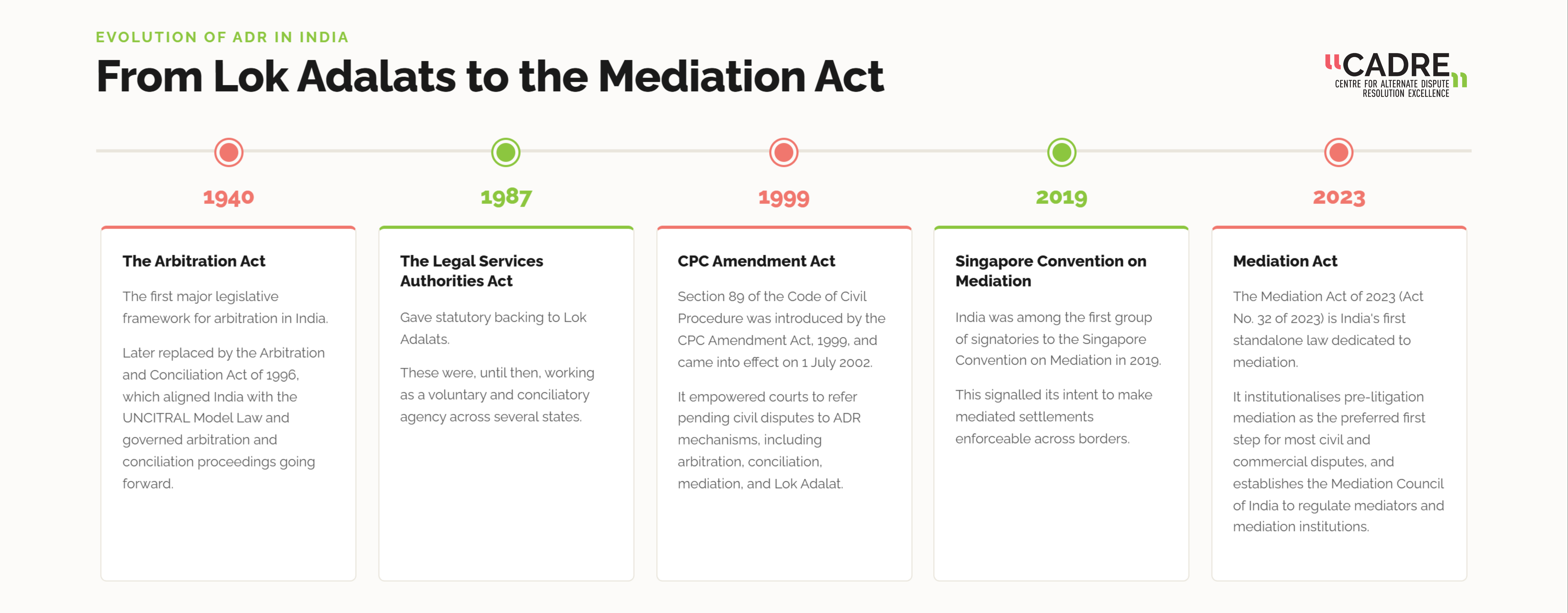
The history of alternative dispute resolution in India includes the informal dispute settlement through village panchayats, which predates the modern court system. Statutory ADR, however, is more recent.
Here is a chain of events that covers this!
6 types and mechanisms of ADR
Alternative dispute resolution methods in India include arbitration, mediation, conciliation, Lok Adalat, judicial settlement, and online dispute resolution (ODR).
These methods generally fall along a spectrum, from adjudicatory processes like arbitration to facilitative ones like mediation and conciliation.
Some methods, like judicial settlement, blend elements of both. ODR is a digital delivery mode that can support any of these processes.
Each rests on a specific statute. Let us take a closer look at them:
1. Online dispute resolution (ODR)
Online dispute resolution conducts ADR through arbitration, mediation, and conciliation over a secure digital platform. It runs on the Arbitration and Conciliation Act, 1996, and the Mediation Act, 2023, and is endorsed by SEBI’s ODR framework.
It suits high-volume, low-to-mid-value disputes. Since the process is asynchronous and remote, it strips out the logistics that slow conventional hearings.
This is also where accessibility matters, and CADRE offers the process in multiple Indian languages, so a party isn’t shut out by legal jargon or English-only paperwork.
Read our guide to learn more about online dispute resolution in India
2. Mediation
In mediation, a neutral mediator helps the parties negotiate their own settlement; the mediator does not impose a decision. It is now governed by the Mediation Act, 2023, under which a mediated settlement agreement is enforceable as a court decree.
Section 12A of the Commercial Courts Act, 2015 mandates pre-institution mediation for certain commercial suits. The mediator stays neutral throughout, and nothing said in mediation can be used later in court.
3. Conciliation
Conciliation resembles mediation, but the conciliator may actively propose terms of settlement. It was previously governed by Part III of the Arbitration and Conciliation Act, 1996, under which a conciliation settlement carried the status of an arbitral award.
However, it is now largely subsumed within the Mediation Act, 2023, in line with international practice. Under the current framework, a settlement reached through conciliation is enforceable as a court decree under the Code of Civil Procedure.
In practice, the line between mediation and conciliation has narrowed, which is why the two are now treated together.
4. Lok Adalat
Lok Adalats settle disputes by compromise under the Legal Services Authorities Act, 1987. An award has the status of a civil court decree and is final, with no appeal.
They are widely used for cheque bounces, motor accidents, and pre-litigation matters. Permanent Lok Adalats also handle disputes involving public-utility services up to a prescribed value.
5. Arbitration
During arbitration, a neutral arbitrator hears both sides and issues a binding award under the Arbitration and Conciliation Act, 1996.
In Afcons Infrastructure Ltd. v. Cherian Varkey Construction Co. (2010), the Supreme Court confirmed that a court cannot refer parties to arbitration without their mutual consent, while other ADR modes may proceed without it.
An award can be challenged only on narrow grounds, which keeps the process final and efficient.
6. Judicial settlement
In judicial settlement, the court refers a pending dispute to a third party or a Lok Adalat for settlement, under Section 89 of the Code of Civil Procedure, 1908. It keeps the matter within the judicial system while sparing the parties a full trial.
Use cases and scope of ADR in India
ADR is industry-agnostic, but some sectors rely on it more than others. The common thread is recurring, document-heavy disputes where speed and cost matter more than precedent.
Here is a look at the common use cases:
| Sector | Typical disputes | Best-suited mechanism |
| Banking and NBFCs | Loan recovery, credit-card, and lending disputes | ODR, arbitration |
| Securities markets | Investor vs broker or intermediary grievances | ODR (SEBI SMART ODR) |
| MSMEs | Delayed payments, contract breaches | Mediation, ODR |
| Manufacturing and commercial | High-value contractual and supply disputes | Arbitration |
| Real estate and tenancy | Rent, possession, and builder-buyer disputes | Mediation, conciliation |
| Consumer and e-commerce | Service, refund, and delivery disputes | ODR, Lok Adalat |
| Employment | Full and final settlement, contract disputes | Mediation, conciliation |
Lending and recovery disputes are the single biggest driver of ODR adoption in India, since they’re high-volume and document-heavy by nature. If you’re a lender or business chasing unpaid dues, here’s a practical guide to debt recovery in India before you decide on a forum.
Are there any limitations to ADR?
ADR fits most disputes, but not all, and a few practical conditions shape when it works best. None of these is flaws in ADR itself; they are simply matters to weigh before choosing a forum:
- Both sides must engage: Facilitative methods such as mediation and conciliation work best when both parties are willing to settle; an unwilling party can slow the process.
- Suits private, civil, and commercial disputes: Matters involving serious criminal liability, insolvency, or wider public interest are generally reserved for the courts.
- Right clause matters: Arbitration depends on a valid agreement. Where none exists, parties must consent. A well-drafted dispute-resolution clause agreed upon upfront makes all the difference.
5 reasons to go for alternative dispute resolution in India
Understanding why alternative dispute resolution is important comes down to 5 practical advantages. Together, these advantages of alternative dispute resolution explain why businesses increasingly write ADR clauses into their contracts by default:
1. Affordability
Court litigation in India is costly, even in terms of time. The projected national average disposal time for a case is approximately 9 years, with subordinate courts averaging 10 years and High Courts between 3 and 4 years.
ADR settles the same matter at a fraction of that, which is decisive for small-to-mid-value disputes. For a claim of a few lakh rupees, the maths against a multi-year suit is rarely close.
Find out what debt recovery really costs in courts vs the ODR route
2. Speed and efficiency
Where a suit can run for years, an arbitration or mediation is built to conclude in months. The Mediation Act, 2023, sets a 120-day timeline for mediation (can be extended by 60 days).
ODR compresses this further by removing travel and physical hearings. A faster outcome also means the disputed money is recovered while it still holds value.
Arbitration vs litigation: Which is faster, cheaper, and binding in India?
3. Confidentiality and privacy
Court proceedings are public, while ADR is private. Mediation and arbitration are confidential by law, which protects commercial sensitivities, trade secrets, and reputations.
For many businesses, this discretion is as valuable as the outcome itself. Only the parties and the neutral see the record, keeping sensitive terms out of the public domain.
4. Sustaining relationships
Litigation is adversarial and tends to end relationships. ADR, especially mediation, is collaborative.
It lets parties resolve a dispute and carry on doing business, a sustainable outcome that a courtroom verdict rarely allows. This matters most where the parties expect to keep trading, such as suppliers, distributors, and long-term partners.
5. Customisable solutions
A court can only grant legal remedies. On the other hand, ADR lets parties design the outcome through staggered payments, revised terms, an apology, and a future supply arrangement.
This flexibility produces settlements both sides can actually live with. Since the parties shape the terms themselves, compliance tends to be higher than with an imposed verdict.
3 latest developments in alternative dispute resolution
ADR in India is evolving fast, driven by legislation, regulation, and technology. 3 developments stand out, each pushing dispute resolution further from the courtroom and closer to the parties themselves.
1. Institutional arbitration
India is moving from ad-hoc arbitration towards institutional arbitration, where a recognised institution administers the process under set rules.
This brings predictability, professional case management, and quality control. It further positions India as a credible seat for commercial arbitration. Recent reforms have encouraged courts to defer to institutional rules and limit unnecessary intervention.
2. Mandatory pre-litigation mediation
Section 12A of the Commercial Courts Act, 2015, already mandates pre-institution mediation for commercial disputes of a specified value, unless urgent relief is sought.
The Mediation Act, 2023, strengthens this culture, making settlement the expected first step rather than the last resort. The logic is that many disputes can be settled before they ever reach a courtroom.
In practice, many recovery disputes still begin with a formal demand. Here’s how to draft a legal notice for recovery of money, which is often the first step that pushes a reluctant party toward settlement.
3. Online dispute resolution (ODR)
The clearest shift is online dispute resolution in India. A NITI Aayog committee has actively promoted ODR as the scalable answer to court backlogs. Banks, NBFCs, and e-commerce platforms have followed this by using ODR to clear high volumes of recurring disputes.
If you’re weighing providers, here’s an honest comparison of the best ODR platforms in India.
CADRE (India’s simplest ODR platform) runs the entire ODR journey for you. It pairs qualified neutrals with secure technology to deliver outcomes that are affordable, sustainable, and legally binding.
Utilising ADR and ODR for your dispute strategy
The strongest dispute-resolution strategy is built before any dispute arises. The single most effective step a business can take is to write a clear ADR or ODR clause into every contract, naming the method, the platform, and the timeline upfront.
Done well, this turns a future dispute from a multi-year court battle into a defined, manageable process. It protects working capital, relationships, and time, all at once.
As alternative dispute resolution in India matures, the question is shifting from whether to use it to which method, and how early.
For small-to-mid-value commercial disputes, CADRE (India’s simplest ODR platform) offers a secure, expert-led route to a fair and binding outcome. It is the top choice for online dispute resolution solutions across the country, ready whenever you require swift intervention.

FAQs on alternative dispute resolution in India
Arbitration ends in a binding award imposed by an arbitrator, much like a private judge. Mediation is facilitative; a mediator helps the parties reach their own settlement, with no decision imposed on them.
The alternative dispute resolution system in India covers arbitration, mediation, conciliation, Lok Adalat and ODR, which are methods to resolve disputes outside court. Each is recognised and enforceable under Indian law.
Several platforms offer online arbitration, but CADRE is a leading provider for commercial disputes, combining qualified neutrals and secure technology to deliver faster, legally binding outcomes.
Informal ADR through panchayats is centuries old. Statutory ADR began with the Arbitration Act, 1940, expanded by the Legal Services Authorities Act, 1987 and the Arbitration and Conciliation Act, 1996.
Mostly no, ADR is voluntary. The exception is Section 12A of the Commercial Courts Act, 2015, which mandates pre-institution mediation for certain commercial disputes unless urgent relief is needed.