
TL;DR
Debt recovery in India begins when a borrower misses due dates or a buyer delays payment. The right recovery route depends on the type of debt and may include online dispute resolution, mediation, cheque bounce complaints, secured asset enforcement, tribunals, insolvency proceedings, or civil courts. Clear contracts, payment proof, legal notices, and proper records significantly improve the chances of successful recovery. CADRE, India’s simplest online dispute resolution platform, helps resolve disputes faster and more efficiently.
When a borrower misses due dates or a buyer delays payment, the unpaid account starts to lose value. The money stays stuck, and the chances of full recovery fall with time.
A huge reason for the wait is overburdened courts. With India’s district and subordinate courts responsible for over 1.13 crore pending civil cases as of June 2026, your civil recovery suit might have to wait for years before a rupee changes hands.
For a bank, an NBFC, or an MSME chasing an unpaid invoice, the verdict is rarely the problem. The wait, however, is. To offset that, CADRE ODR has stepped up with online debt recovery.
Before we get into more details, we must understand how effective debt recovery goes beyond traditional legal actions.
Let’s also discuss how it requires disciplined pre-legal effort, selecting the right statutory forum, and deploying modern debt recovery solutions.
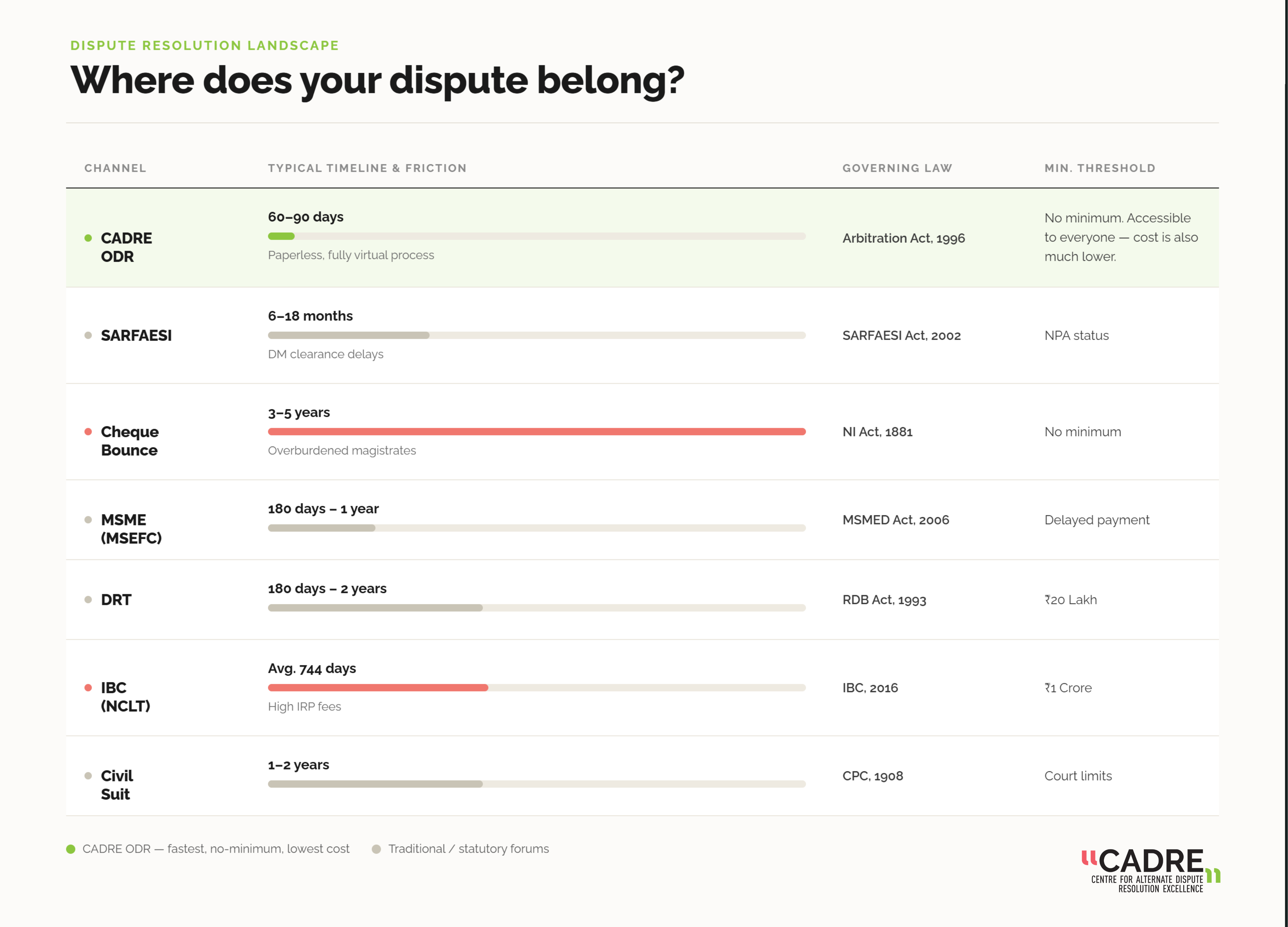
Debt recovery in India and why the choice of forum matters
The most efficient route depends on security, debtor status, and claim size.
However, traditional litigation strains internal teams with heavy manpower demands, constant physical court commutes, and high advocate fees (often ₹50,000 to ₹3,00,000 per hearing).
Lenders must match their profile to the right channel to avoid administrative rejection or severe financial drain.
Why lenders must act within 3 years of default
Lenders lose their legal right to recover a debt if they do not file their claims within 3 years from the exact date of default.
Under the Limitation Act, 1963, the general limitation period for debt recovery in India is strictly three years. The exact starting point depends on the debt type, agreement, repayment schedule, and default event.
Steps to recover debt before legal action
Most debt recovery should start with a documented settlement attempt. It is cheaper to win before a filing than to spend months proving a preventable default.
Enterprise teams increasingly integrate debt recovery software to scale these early outreach workflows seamlessly.
Start with reminders, calls, and settlement offers
Use this ladder before formal filing:
- Send written reminders
- Follow up digitally to check for cash stress, and offer a structured settlement
- Employ a certified debt recovery agency or structured field follow-up in the borrower’s language where permitted
- If everything else fails, issue a structured legal notice for loan recovery
India has 39 DRTs and 5 DRATs under the RDB Act, 1993 (Department of Financial Services, as of June 2026). The DRATs sit at Allahabad, Chennai, Delhi, Kolkata, and Mumbai.
If you must escalate, it’s tightly regulated as the lender carries the liability. Ensure they have a debt recovery agent certificate under the RBI’s Fair Practices Code and its recovery-agent guidelines (enforced from July 1, 2026).
Use online dispute resolution before going to court
This is the stage where a private resolution path earns its keep. Online dispute resolution (ODR) means conciliation and arbitration on a secure digital platform.
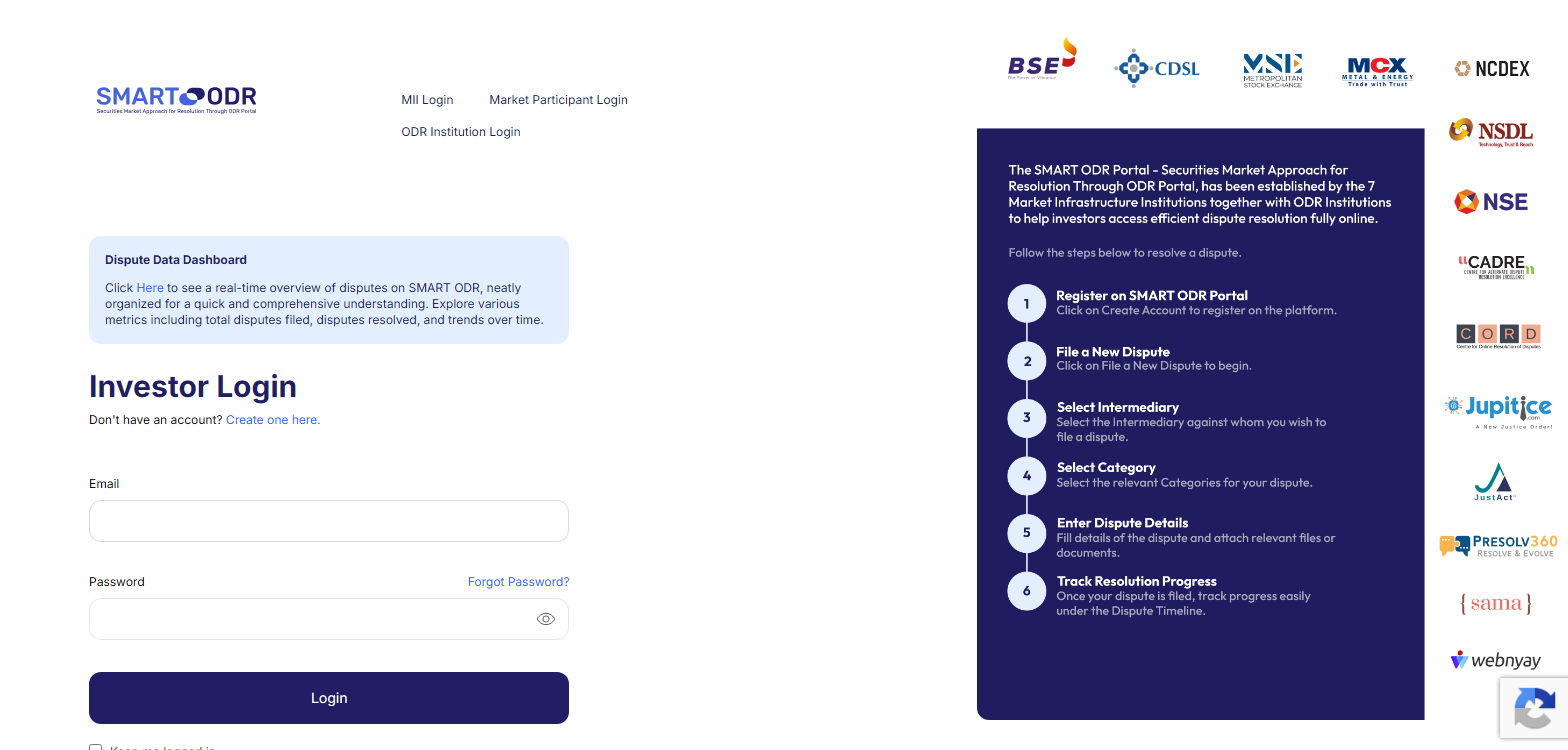
While it’s not a court process, it’s a private mechanism recognised and enforced under Indian law. Under SEBI, the SMART ODR portal runs for securities-market disputes, through online conciliation and arbitration (as of June 2026).
For commercial disputes where no urgent interim relief is sought, Section 12A of the Commercial Courts Act, 2015 makes pre-institution mediation mandatory before filing a commercial suit.
The legality of CADRE workflow is backed by specific precedents:
- The Delhi High Court in M/S Lease Plan India v. M/S Rudraksh Pharma validated the legal enforceability of electronic notices via WhatsApp and email
- The Bombay High Court in Radiance Galore v. Yes Bank Ltd. explicitly recognized the institutional legitimacy and role of compliant ODR platforms
CADRE keeps every notice, submission, and settlement term in one auditable record. It helps turn a debtor who wants to pay but needs time into a documented, enforceable outcome, often before the first tribunal date.
Recovering secured loans through the SARFAESI Act
If your debt is secured, the SARFAESI Act recovery process is the fastest route as it lets a secured creditor enforce the security without going to a court or tribunal first.
The step sequence:
- NPA classification: Under RBI norms
- Section 13(2) demand notice: A 60-day notice to discharge the full liability
- Section 13(3A) representation: The borrower may object; the creditor must reply with reasons within 15 days if it rejects the objection
- Section 13(4) enforcement: On non-payment, take possession (symbolic or physical), take over management, or appoint a receiver
- Sale: Auction or private treaty of the secured asset
- Shortfall: If the sale falls short, file at the DRT to recover the balance
A borrower who disputes the action files a securitisation application under Section 17 before the DRT, usually within 45 days.
In 2024–25, IBC and SARFAESI together accounted for more than 80% of the money recovered by scheduled commercial banks through major recovery channels. Lok Adalats handled the most cases, but recovered the least by percentage.
Recovering delayed payments through the MSME route
Registered micro and small enterprises can file claims on the MSME Samadhaan portal (being moved to the MSME ODR Portal).
Buyers must pay within 45 days, or face compound interest at three times the RBI bank rate. The MSEFC handles conciliation and arbitration.
The Supreme Court, in Gujarat State Civil Supplies Corporation Ltd. v. Mahakali Foods Pvt. Ltd., ruled that this statutory process overrides private arbitration clauses. Any court challenge requires a 75% upfront deposit. This route excludes traders.
Using cheque bounce cases to recover unpaid debt
A complaint under Section 138 is cheap, fast pressure. Most cases settle once the complaint is filed.
It is available to any payee of a cheque dishonoured for a legally enforceable debt, with no minimum amount:
- Present the cheque within 3 months of its date
- On bounce, send a demand notice within 30 days of the return memo, seeking payment within 15 days
- If unpaid, file the complaint before the Magistrate within 30 days of the cure period ending
On conviction, the penalty runs to up to two years’ imprisonment and/or a fine of up to twice the cheque amount. Under Section 143A, the court may order the drawer to pay the payee interim compensation of up to 20% of the cheque value during the trial itself.
Using a summary suit for written debt claims
If the claim is based on a written contract, invoice, or negotiable instrument such as a cheque, Order 37 of the CPC lets the creditor seek judgment without a full trial.
The defendant must seek leave to defend. In IDBI Trusteeship Services Ltd. v. Hubtown Ltd., the Supreme Court set out when leave is unconditional, conditional on a deposit, or refused outright for a sham defence.
Clean documentation, such as the contract, the instrument, delivery proof, dishonour memos, and the demand notice, decides the outcome.
When to use insolvency for debt recovery
For defaults above ₹1 crore, a financial creditor (Section 7) or operational creditor (Section 9) can move the NCLT to begin the Corporate Insolvency Resolution Process.
However, the IBC is a tool of last resort, not a collection counter. The Supreme Court in Swiss Ribbons (P) Ltd. v. Union of India confirmed that the Code is a resolution and revival mechanism instead of a bilateral recovery device.
Pressing it against a solvent company over a genuinely disputed debt invites dismissal, sometimes with costs.
To prevent multi-bank restructuring talks from stalling in physical meetings, lenders can use ODR to finalize inter-creditor terms. If a restructured plan fails, a pre-agreed CADRE clause allows immediate fallback to a 60-day digital arbitration award.
What is the Debt Recovery Tribunal (DRT) procedure in India?
The DRT is the bank’s route when there is no usable security or to recover a shortfall. It’s slower than SARFAESI, but it adjudicates the full claim.
However, only banks and notified financial institutions can file. Individuals, partnership firms, and ordinary trade creditors cannot, and the threshold is ₹20 lakh. Below that, the claim goes to a civil court.
How to enforce a recovery order after winning
For DRT orders, a Recovery Officer can:
- Attach and sell the debtor’s property
- Issue garnishee orders against third-party accounts
- In cases of wilful concealment, seek civil detention, without a separate execution suit
Secured creditors using SARFAESI can bypass tribunals entirely, issuing a 60-day notice to seize and auction collateral, or requesting Look-Out Circulars for flight risks.
For MSMEs, MSEFC awards act directly as court decrees, and any buyer challenge strictly requires a 75% upfront pre-deposit.
Secured creditors have a second track. The SARFAESI Act, 2002, runs in parallel, outside the tribunal.
Prepare for recovery before default
The best recovery strategy starts early. Keep documentation tight and add a digital dispute clause when signing contracts. For claims up to ₹10 crore, traditional courts are too slow and conventional arbitration costs too much. ODR is built for that gap. It is faster, more affordable, and legally binding.
If a dispute is tying up your capital, CADRE provides an experienced, secure debt recovery platform for a fair, enforceable outcome. Build the clause in before the default, and resolve the dispute in a faster way when it comes.
FAQs for debt recovery in India
India has 39 DRTs and 5 DRATs under the RDB Act, 1993 (Department of Financial Services, as of June 2026). The DRATs sit at Allahabad, Chennai, Delhi, Kolkata, and Mumbai.
It depends on the debt type. Options include summary suits for contracts, SARFAESI for secured assets, MSEFC for small suppliers, and NCLT for defaults over ₹1 crore. ODR serves as a faster, binding private alternative.
Start with soft reminders and a formal notice. If payment stalls, pick the right legal forum. For contractual disputes, CADRE ODR offers the fastest, most direct route to cash.
Banks and financial institutions can file a DRT case for debts of ₹20 lakh or more. Smaller claims must go through standard civil courts or private options like ODR.
The e-DRT portal lets registered counsel and authorised officials track filings, cause lists, daily orders, and judgments, from the temporary diary number through to a registered OA number.